 +91-8727000867
 +64 22 003 5555


Highlights
- Stats show excess inventory can increase storage costs by up to 30%.
- Stats indicate stockouts may cause around 20–25% loss in potential sales.
- Stats reveal AI forecasting can improve accuracy by nearly 20–50%.

Co-Founder
Vandana Abrol 
An enthusiastic developer and skilled business management expert with over a decade of experience in the field
Introduction
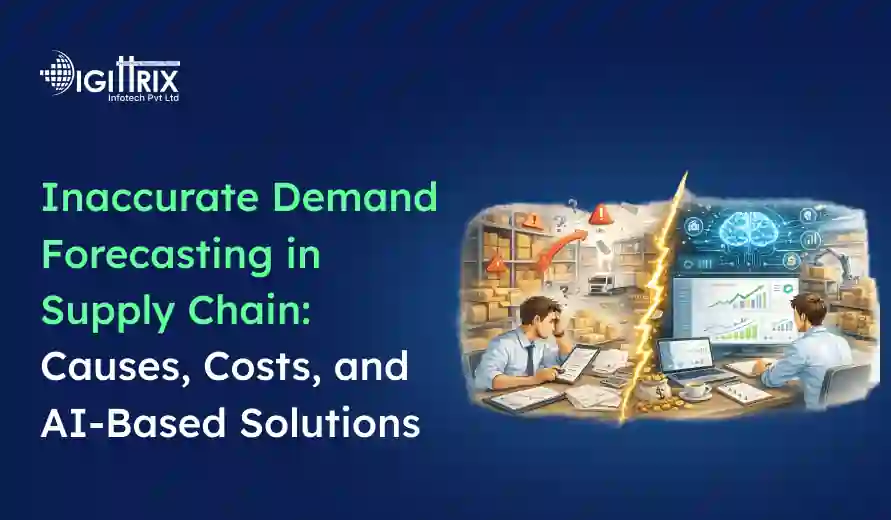
Demand forecasting is central to supply chain planning. It helps businesses decide how much to produce, store, and distribute over a given period. When predictions closely match actual demand, operations run smoothly. However, when forecasts miss the mark, companies face serious issues such as stockouts, excess inventory, delayed deliveries, and financial losses. This is where AI-driven demand forecasting in the supply chain is gaining attention as businesses seek greater accuracy.
In today’s fast-changing markets, predicting demand has become more difficult than ever. Customer preferences shift quickly, external conditions change without warning, and global supply chains are more complex than ever. Many businesses still rely on traditional forecasting methods, which often fail to address these challenges.
This article explains the main reasons for inaccurate demand forecasting, the direct and hidden costs associated with it, and how AI-based solutions can help businesses improve accuracy and decision-making.
Optimize stock with automated inventory forecasting .
What is Demand Forecasting in a Supply Chain?
Demand forecasting is the process of estimating future customer demand for products or services. It uses historical data, market trends, seasonal patterns, and business knowledge to predict what customers will need and when.
Accurate forecasting helps businesses
- Maintain optimal inventory levels
- Reduce storage and holding costs
- Avoid stock shortages
- Improve customer satisfaction
- Plan production efficiently
Forecasting methods can be broadly divided into two types:
- Qualitative methods: Based on expert judgment, market research, and opinions
- Quantitative methods: Based on historical data and statistical models
While both methods have their place, relying too heavily on outdated data or human assumptions can lead to poor predictions and common errors in supply chain demand forecasting.
Major Causes of Inaccurate Demand Forecasting
1. Poor Data Quality
Forecasting depends heavily on data. If the data used is incomplete, outdated, or incorrect, the forecast will be inaccurate. Common data issues include:
- Missing sales records
- Incorrect product categorization
- Data entry errors
- Lack of real-time updates
When businesses rely on flawed data, even advanced models cannot produce accurate results, leading to serious inventory-forecasting problems.
2. Overdependence on Historical Data
Many companies rely solely on past sales data to forecast future demand. While historical data is useful, it does not always reflect current market conditions. Sudden changes, such as new competitors, economic shifts, or shifts in customer behavior, can render past trends irrelevant.
For example, a product that sold well last year may not perform as well this year due to shifting preferences. This is one of the key challenges in demand forecasting in logistics.
3. Ignoring External Factors
Demand is influenced by several external factors, such as:
- Economic conditions
- Weather changes
- Political events
- Market trends
- Social media influence
Traditional forecasting methods often omit these variables, leading to inaccurate predictions and repeated errors in supply chain AI demand forecast development.
4. Lack of Collaboration Between Departments
In many organizations, departments such as sales, marketing, and supply chain operate in isolation. This lack of communication creates information gaps.
For instance:
- Marketing may plan a promotion without informing the supply chain team
- Sales may expect higher demand without sharing updates
This disconnect results in forecasts that do not reflect actual business plans.
5. Seasonal and Demand Variability
Some products experience seasonal demand fluctuations. If businesses fail to account for these patterns, their forecasts become inaccurate.
Examples include:
- Increased demand for clothing during festive seasons
- Higher sales of cold drinks in summer
- Increased demand for electronics during sales events
Ignoring such patterns can worsen inventory forecasting problems.
6. Human Bias and Judgment Errors
Manual forecasting often relies on human judgment, which can introduce bias. Common biases include:
- Overconfidence in certain products
- Personal assumptions not backed by data
- Pressure to meet targets
These biases can distort forecasting results.
7. Rapid Market Changes
Modern markets are dynamic. Trends shift quickly due to factors like:
- Online shopping behavior
- Influencer impact
- Sudden viral products
Traditional forecasting models struggle to keep pace with such rapid changes, increasing AI demand forecasting services, and challenges in logistics.
 AI-Powered Demand Forecasting for Modern Businesses
Leverage machine learning and real-time data analytics to improve demand prediction accuracy and strengthen your supply chain operations.
Costs of Inaccurate Demand Forecasting
Poor forecasting does not just affect planning; it directly impacts a company’s financial performance and customer experience.
1. Excess Inventory Costs
When demand is overestimated, businesses produce or order more goods than required. This leads to:
- Increased storage costs
- Risk of product damage or expiry
- Capital tied up in unsold goods
2. Stockouts and Lost Sales
Underestimating demand leads to stock shortages. When products are unavailable, shortages occur:
- Customers turn to competitors
- Sales opportunities are lost
- Brand reputation suffers
3. Higher Operational Costs
Inaccurate forecasts lead to inefficient operations, including:
- Emergency production runs
- Expedited shipping costs
- Over time, labor expenses
These issues highlight the need for improved demand planning solutions for logistics.
4. Poor Customer Satisfaction
Customers expect products to be available when needed. When businesses fail to meet demand, they risk losing customers.
- Delivery delays occur
- Orders get canceled
- Customer loyalty decreases
5. Wastage and Obsolescence
For products with short life cycles, excess inventory can become obsolete, resulting in:
- Product write-offs
- Discounted sales to clear stock
- Financial losses
6. Reduced Profit Margins
All of the above factors directly affect profit margins over time.
Limitations of Traditional Forecasting Methods
Traditional methods rely heavily on statistical models and human judgment. While useful, they have several limitations:
- Limited ability to process large datasets
- Difficulty in handling real-time changes
- Inability to analyze unstructured data, such as social media trends
- Slow response to sudden demand shifts
These gaps are why businesses are adopting AI for supply chain forecasting.
Scale Your Business with Smart Demand Planning
Use AI-powered forecasting to align production, inventory, and distribution with real customer demand for sustainable growth.
AI Demand Forecasting in Supply Chain: Smarter Approach with Data
Artificial Intelligence offers a new approach to demand forecasting by using advanced algorithms and data analysis techniques. Custom AI demand forecasting in the supply chain helps businesses process large volumes of data and identify patterns that traditional methods may miss.
1. Machine Learning Models
Machine learning models analyze historical and real-time data to detect patterns and trends.
Key features include the following:
- Continuous learning from new data
- Ability to handle complex relationships
- Better accuracy in dynamic environments
These models are a core part of predictive analytics in the supply chain.
2. Real-Time Data Processing
AI systems can process data in real time, enabling businesses to respond quickly to changes in demand.
This includes:
- Live sales data
- Market trends
- Customer behavior
3. Demand Sensing
Demand sensing focuses on short-term forecasting using real-time data.
This approach improves responsiveness and supports logistics demand planning solutions.
4. Integration of External Data
AI models can incorporate external data sources, such as
- Weather forecasts
- Economic indicators
- Market trends
This improves overall forecast accuracy.
5. Automated Forecasting
AI reduces manual work by automating forecasting processes.
Benefits include:
- Faster decision-making
- Consistent forecasting
- Reduced human bias
6. Scenario Planning
AI systems can simulate different scenarios under various conditions.
This helps businesses prepare for uncertainty.
Future of AI Demand Forecasting in Supply Chain
The future of AI demand forecasting in the supply chain depends on data-driven systems and smarter models.
Key trends include:
- Increased use of AI tools
- Greater reliance on real-time data
- Improved collaboration across supply chains
Businesses that adopt modern forecasting methods will be better prepared for future challenges.
Looking to streamline your business processes? Explore essential supply chain features to boost efficiency and growth.
Final Words
Inaccurate demand forecasting remains a major challenge in supply chain management. It leads to excess inventory, stockouts, higher costs, and poor customer satisfaction. The main causes include poor data quality, lack of coordination, reliance on outdated methods, and an inability to respond to rapid market changes.
AI-driven demand forecasting in the supply chain offers a practical way to address these issues. By analyzing large datasets, processing real-time information, and reducing human bias, AI improves forecasting accuracy and supports better decision-making.
While adopting AI requires investment and planning, the long-term benefits outweigh the challenges. Businesses that improve their forecasting can reduce costs, manage inventory more effectively, and meet customer demand more consistently.
Improve Demand Forecasting Accuracy with AI-Based Solutions at Digittrix
Struggling with inaccurate demand forecasts in your supply chain? It’s time to adopt smarter, data-driven solutions that help you reduce errors, control inventory, and plan operations with greater clarity. At Digittrix, we help businesses implement AI-based forecasting systems that support better decision-making and improve overall supply chain performance.
Our experienced team builds intelligent solutions that analyze historical data, real-time inputs, and market trends to deliver more accurate demand forecasts. Whether you are dealing with stock shortages, excess inventory, or planning challenges, we develop systems that help you forecast demand with greater precision and consistency.
Digittrix is a trusted website and app development company with experience since 2014. We focus on delivering scalable AI solutions that help businesses reduce forecasting errors, improve planning, and gain better control over supply chain operations.
If you are unsure how to get started, our experts are here to guide you through every step—from understanding your forecasting challenges to selecting the right AI models and planning implementation. Schedule a consultation today by calling +91 8727000867 or emailing digittrix@gmail.com to build a smarter demand-forecasting system for your business.

 FAQ's
FAQ's