 +91-8727000867
 +64 22 003 5555


Manufacturing ERP Software 2026: Scalable Factory System Guide
Quick takeaway: Plan scalable manufacturing ERP software in 2026 with inventory, production planning, purchasing, sales orders, cloud deployment, automation, reporting, migration, training, and rollout KPIs.
Planning ERP, CRM, or automation software? Review service details, ERP planning, and CRM workflow guides.
ERP and CRM development services | Custom ERP development guide | Custom CRM planning guide
After ERP implementation, the manufacturer had a clearer way to track production status, inventory movement, warehouse activity, approvals, and reporting from one connected ERP workflow.
Highlights
- Manufacturing ERP planning should start with inventory, production, purchasing, sales order, warehouse, reporting, and approval workflows.
- A scalable ERP build needs clean master data, role-based access, audit logs, cloud or hybrid deployment planning, and phased module rollout.
- Measure success with inventory accuracy, production order completion, purchase cycle time, stockout rate, reporting usage, user adoption, and manual hours saved.

Co-Founder
Harsh Abrol 
Since 2014, Digittrix has helped companies optimise digital products for stronger conversions.
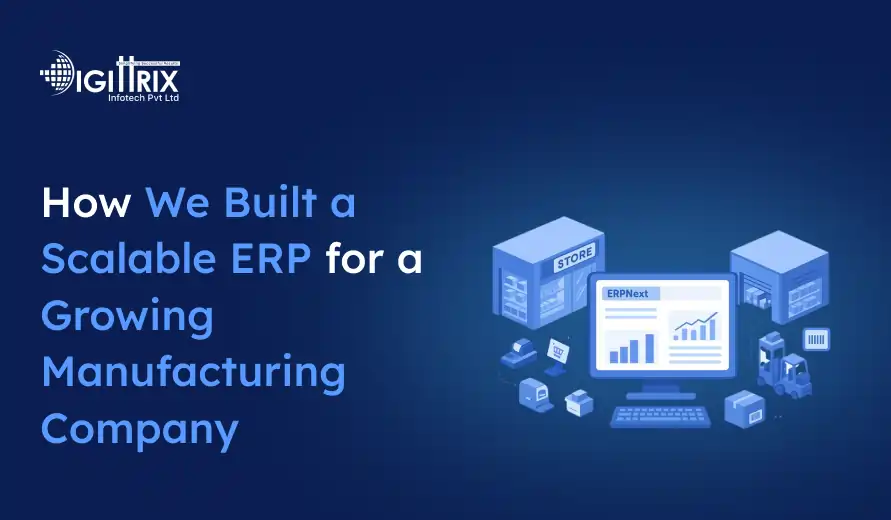
Manufacturing companies handle many complex tasks every day. Tracking raw materials, planning production, scheduling machines, controlling inventory, and managing orders must all work seamlessly together. As a manufacturing business expands, managing these tasks in spreadsheets or disconnected systems becomes more difficult. Data stays scattered, communication slows, and teams waste extra time verifying information.
A mid-sized company contacted our team after encountering similar challenges. Their production capacity had increased, but their internal systems lagged behind the business expansion. They required a centralized manufacturing ERP software solution that could connect departments, minimize manual work, and support future growth.
The goal was to create a unified system that could manage purchasing, inventory, production, sales, and reporting. Instead of using separate tools for each department, employees would work from a single platform where information updates instantly and remains consistent across the entire company.
This article describes how we planned, designed, and built the ERP system step by step, keeping scalability and operational clarity as our main priorities.
Looking to streamline your business operations? Check Digittrix's Custom ERP Development insights to scale your business efficiently!
Understanding Business Operations Before Building ERP Software
Before starting development, we took time to understand how the company operated daily. Manufacturing processes involve many interconnected steps, so carefully studying these workflows was essential.
The company had three production units and multiple warehouses. Their warehouse team maintained inventory records using spreadsheets, while the production department relied on printed reports to plan manufacturing tasks. Sales teams used separate software for order tracking, and the accounts department managed invoices with accounting software that was not connected to other systems.
Because these systems were not integrated, employees often had to verify information manually. For example, production managers frequently contacted the warehouse to check material availability before scheduling manufacturing jobs. If inventory sheets were not updated, production planning became inaccurate.
During our research phase, we held meetings with warehouse staff, production supervisors, purchasing officers, sales managers, and finance teams. Each department described how it managed its tasks and pointed out where delays or errors occurred.
Through this process, we pinpointed key areas where ERP software for manufacturing companies can deliver significant improvements.
- Real-time inventory tracking
- Structured production planning
- Centralized purchase management
- Connected sales and production data
- Automated reporting for management
Once these needs were clearly identified, we began planning the system architecture.
System Architecture for Manufacturing ERP Software
A key requirement for the project was scalability. The company planned to increase production capacity and open more warehouses in the future. This meant the ERP system had to support more users and handle larger volumes of operational data.
We created a modular architecture for the manufacturing ERP software. Instead of developing a single large application that manages everything, we split the system into separate modules linked through APIs.
Each module focused on a particular business function, such as inventory management, production planning, purchasing, sales management, and reporting. This structure enabled the system to expand without disrupting existing components.
Another important decision involved deployment. The system was implemented as a cloud-based ERP system, which allowed employees to access the platform from different locations using secure login credentials.
Using cloud infrastructure offered several advantages:
- Employees could access the system from any branch
- System updates could be applied centrally
- Data backups remained automated
- The company could add users without installing software on every computer
This architecture also simplified maintenance and system monitoring.
 Build Scalable ERP Software for Your Manufacturing Business
Looking to streamline production, inventory, purchasing, and sales with a centralized ERP system? Talk to Digittrix experts today.
Core Modules of the Manufacturing ERP Software
Once the architecture was finalized, we started developing the core ERP modules needed for daily operations. These modules reflected the workflow we had documented during the planning stage.
Inventory Management
Inventory tracking was the initial module developed because many other processes rely on precise stock data.
We developed an inventory management ERP system that monitors all material movements in real time. The system tracks raw materials, work-in-progress items, and finished products across multiple warehouses.
Warehouse staff can log incoming materials, internal transfers, and outgoing shipments directly through the custom ERP system. Each transaction automatically updates stock levels.
Low-stock alerts were also included. When material quantities drop below the predefined level, the purchasing department receives a notification so that new orders can be placed on time.
Production Planning
Production planning used to rely on spreadsheets that needed constant manual updates. The ERP system replaced this method with a structured production management module.
Managers can generate production orders based on customer demand or inventory needs. Each order includes details about necessary materials, assigned machines, and expected completion dates.
Production supervisors can monitor work progress directly from the dashboard. The system shows active tasks, finished batches, and pending work orders. This offers a clear snapshot of factory activity at any given moment.
Purchase and Vendor Management
Manufacturing companies work with multiple suppliers who supply raw materials, components, and packaging materials. The ERP system includes a purchase management module where vendor records, pricing data, and purchase histories are stored.
Purchase officers can generate purchase orders directly through the ERP platform. When materials arrive at the warehouse, staff confirm the delivery in the system, which automatically updates inventory levels.
This connection between purchasing and inventory helps prevent duplicate orders and improves planning accuracy.
Sales and Order Processing
The ERP system also manages customer order processing. Sales teams can create and track orders while monitoring their status through production and delivery.
When a sales order is confirmed, the system automatically links it to the production planning module. This guarantees that manufacturing schedules align with customer demand.
Invoices and delivery documents can also be generated directly through the ERP interface, making the order fulfillment process more straightforward.
Building the Platform Through Custom ERP Development Services
The company assessed various pre-made ERP solutions before selecting a custom-developed platform. Generic systems often have many unneeded features while missing industry-specific functions needed for manufacturing.
To overcome these limitations, the company partnered with a development team that offers custom ERP development services. This enabled us to design the system around their workflow instead of forcing employees to adapt to prebuilt structures.
Throughout the development process, we held regular meetings with department representatives. Each module was tested with real operational scenarios before progressing to the next stage.
During these sessions, employees proposed improvements that made the system easier to use. For example, warehouse staff requested quick-entry forms for material transfers, while production managers asked for clearer visual indicators of machine workloads.
These adjustments helped build a system that employees found familiar instead of complex.
Modern ERP Solutions for Efficient Manufacturing Operations
Connect inventory, production, purchasing, and sales in one intelligent platform designed to support growing manufacturing businesses.
Supporting Growth With Manufacturing Business Automation Software
After completing the main modules, we focused on automation features that decrease manual work and enhance operational clarity.
The ERP platform offers various features usually found in manufacturing automation software, such as automated inventory alerts, scheduled reports, and approval workflows.
For example, when inventory levels drop below the set threshold, the purchasing team receives an automatic notification. Likewise, production reports and sales summaries can be generated daily without manual effort.
Automation not only saves time but also helps departments stay updated on operational changes without the need for constant communication.
Data Migration and ERP Deployment
Before launching the ERP system, we needed to transfer key data from the company’s existing spreadsheets and software systems.
The migration process included:
- Vendor and supplier records
- Customer data
- Product catalogs
- Current inventory levels
- Open purchase and sales orders
Each dataset was cleaned and verified before importing into the ERP database. This step was vital because inaccurate records could cause confusion once the system went live.
After the data migration, the ERP platform was deployed on the cloud environment. Employees gradually started using the system, beginning with the inventory and purchase modules. Production and sales modules were introduced shortly afterward.
Training sessions were held for each department to ensure employees understood how to carry out daily tasks in the new system.
Improvements Observed After ERP Implementation
Within a few months of implementing the ERP platform, the company saw significant improvements in operational management.
Production managers can now plan manufacturing schedules using real-time inventory data. This reduces delays caused by missing materials.
Warehouse teams spent less time updating spreadsheets because material movements were logged directly in the ERP interface.
Sales teams gained improved visibility into production progress, enabling them to offer accurate delivery timelines to customers.
Management also gained advantages from centralized reporting. Instead of manually gathering reports from various departments, they could analyze production, sales, and purchase data through a single dashboard.
Planning to build an ERP system? Check Digittrix's ERP Development Cost in India guide to understand pricing, features, and investment factors!
2026 Manufacturing ERP Rollout Framework
A scalable manufacturing ERP system should be built around the factory workflow, not around a generic software checklist. Before development starts, document how raw materials, purchase orders, production orders, machine schedules, warehouse movements, sales orders, invoices, and reports move across departments.
Modules to plan first
- Inventory and warehouse: raw materials, work-in-progress, finished goods, transfers, stock adjustments, low-stock alerts, and warehouse-wise availability.
- Production planning: production orders, material requirements, machine or line scheduling, batch status, work progress, and completion tracking.
- Purchasing and vendors: supplier records, purchase orders, delivery confirmation, quality checks, pricing history, and reorder rules.
- Sales and dispatch: customer orders, production links, invoices, packing status, shipment status, and delivery documentation.
- Reporting and controls: dashboards, role permissions, audit logs, approval workflows, backup planning, and KPI reports.
Rollout checks before launch
- Clean product, SKU, vendor, customer, warehouse, and opening stock data before migration.
- Test real workflows with warehouse staff, production supervisors, purchase teams, sales teams, finance users, and management.
- Launch modules in phases so users can adopt the system without blocking daily operations.
- Track adoption with login activity, report usage, data-entry errors, support tickets, and manual work reduced after launch.
GEO and AI-search clarity
For stronger AI search visibility, this page should clearly explain manufacturing ERP software, factory modules, inventory management, production planning, purchasing, sales orders, cloud deployment, migration, training, automation, KPIs, vendor checks, and related ERP planning pages.
For deeper planning, compare our custom ERP development company guide, ERP development cost guide, ERP integration guide, and ERP and CRM development services.
Final Words
Building scalable manufacturing ERP software requires a thorough understanding of manufacturing workflows and careful system planning. In this project, our focus was on developing a platform that connects departments, organizes operational data, and supports business growth without adding complexity.
By carefully designing the system architecture, implementing key modules step by step, and working closely with the company through custom ERP development services, we built a platform that supports daily operations while remaining flexible for future growth.
With the support of a cloud-based ERP system, automated processes similar to manufacturing business automation software, and a structured inventory management ERP system, the company now manages production, inventory, purchasing, and sales from a single centralized platform. As the business continues to grow, the ERP system remains capable of supporting new operational requirements without disrupting existing processes.
Built a Scalable ERP Manufacturing Company with Digittrix
As manufacturing companies expand, managing production, inventory, purchasing, and sales with separate tools becomes challenging. Disconnected systems often cause data confusion and delays in reporting. A centralized ERP platform helps unify all operations into one system.
At Digittrix, we partnered with a growing manufacturing company that required a structured ERP platform to manage its expanding operations. Their processes were managed through spreadsheets and various software tools, which led to operational gaps. Our objective was to create a scalable ERP system that could connect departments and organize business data.
Our team examined their workflow, including production planning, inventory tracking, purchasing, and order management. Based on this review, we created an ERP platform that consolidates these functions into a single system. Employees can now access real-time information from one dashboard, enhancing coordination and reducing manual efforts.
The system was designed with a scalable architecture and cloud deployment so the company can add new users, warehouses, or production units as the business expands.
With experience since 2014, Digittrix develops ERP systems that align with real business workflows. For consultation, call +91 8727000867 or email hello@digittrix.com.
Monthly SEO-GEO support for local businesses that need better visibility, better leads, and clearer reporting.
Do you need help in ERP/CRM Development ?


Join over 1500+ businesses we've already helped!
Recent Posts
 FAQ's
FAQ's
Manufacturing ERP software helps factories manage inventory, production planning, purchasing, vendors, sales orders, finance, reporting, users, and approvals from one connected system.
Most manufacturing ERP rollouts start with inventory, production planning, purchase and vendor management, sales orders, warehouse movement, reporting dashboards, user roles, and approval workflows. Advanced modules can be phased later.
Custom ERP development is useful when manufacturing workflows, machine scheduling, warehouse rules, approvals, reports, integrations, or multi-location operations do not fit a ready-made ERP system.
Cloud ERP can work well for manufacturing teams that need secure access across plants, warehouses, sales offices, or management locations. The setup should include user roles, backups, audit logs, security controls, and reliable connectivity planning.
Useful KPIs include inventory accuracy, production order completion, purchase cycle time, stockout rate, material movement errors, reporting usage, order fulfilment time, manual hours saved, user adoption, and support tickets after launch.
GEO helps when the page clearly explains manufacturing ERP software, modules, inventory, production planning, purchasing, cloud deployment, automation, data migration, implementation steps, KPIs, vendor checks, FAQs, and related ERP planning pages.