 +91-8727000867
 +64 22 003 5555


AI automation helped the client reduce repetitive work, improve support handling, speed up reporting, and create clearer workflow ownership across departments.
Highlights
- Start AI automation with a workflow audit across support, document processing, reporting, and task routing.
- Use human oversight for sensitive decisions, exceptions, quality checks, approvals, and customer escalations.
- Measure results through manual hours saved, response speed, error reduction, report usage, user adoption, and workflow ROI.

Co-Founder
Vandana Abrol 
An enthusiastic developer and skilled business management expert with over a decade of experience in the field
Introduction
This AI automation case study explains how a mid-sized service company reduced operational overhead through structured automation. Many companies expand quickly but keep handling daily operations manually. Over time, this leads to high labor costs, slow responses, and repetitive human effort for simple tasks. The client in this project faced similar issues. Their customer support team managed hundreds of requests daily, employees processed documents by hand, and managers spent hours preparing reports.
Instead of hiring more staff, the company looked for a practical way to handle growth while controlling costs. Our team carefully reviewed the company’s processes and gradually introduced automation. The goal was not to replace workers but to remove unnecessary manual steps that wasted time and money.
This article highlights the problems we identified, the automation systems deployed, and the results after six months. It also shows how a structured automation strategy can improve operational efficiency without disrupting existing teams.
Looking to integrate AI into your business? Check Digittrix's AI Integration Services guide to explore how AI can streamline your operations!
Understanding the Client’s Operational Structure
Before implementing automation, we took time to study how the company managed daily tasks. The business offered a service that involved regular communication with customers. Each day, staff members handled requests, responded to emails, scheduled appointments, verified documents, and prepared internal reports.
The company had grown steadily over the years. However, its internal processes had not kept pace. Many tasks that could be automated were still done manually.
Some departments experienced a heavy workload, while others faced delays due to manual coordination.
The major areas of concern included:
- Customer support request handling
- Document processing and verification
- Internal reporting and performance tracking
- Request routing between departments
- Appointment scheduling
Each of these processes needs several employees to perform repetitive steps daily.
Initial Signs of Inefficient Operations
During the analysis phase, we identified several patterns that indicated operational inefficiencies.
Repetitive Administrative Tasks
Employees spent much of their day entering data, reviewing documents, and responding to routine customer inquiries.
Although these tasks were necessary, they followed rigid patterns and didn't often require human judgment cases.
High Support Ticket Volume
Customer support agents received hundreds of messages daily. Many questions were repeated often including:
- Request status updates
- Payment confirmation
- Account information updates
- Appointment booking assistance
Human agents spent hours responding to similar cases questions.
Slow Internal Coordination
When a customer request arrived, employees had to manually check the request details and forward it to the correct department.
This caused delays and sometimes led to requests being overlooked.
Manual Reporting
Managers relied on daily and weekly reports to monitor operations. These reports were manually created using spreadsheets.
Employees collected data from multiple systems and compiled it into reports, which often took several hours.
Planning the Automation Strategy
Once we understood the client’s workflow, we created a structured automation plan. The strategy aimed to boost productivity while keeping the current workforce unchanged.
The project included four major automation systems:
- AI support assistant
- Automated document processing
- Automated reporting dashboard
- Workflow routing system
Each solution addressed a specific operational issue.
This approach enabled the company to steadily implement automation without disrupting its existing operations processes.
 Implement AI Automation to Reduce Operational Costs
Want to reduce manual work, improve efficiency, and scale operations with AI automation? Digittrix helps businesses automate customer support, document processing, reporting, and workflow management.
AI Automation Case Study Implementation: Customer Support Automation
Customer support was the first department chosen for automation. Our analysis revealed that over half of incoming customer requests were straightforward questions.
To address this issue, we introduced an AI support assistant that can instantly respond to frequently asked questions.
The assistant was integrated into the company’s website and customer portal. Customers could ask questions through a chat interface, and the system responded based on stored information.
If a customer needs help with a complex issue, the system transfers the conversation to a human agent.
Within two months of implementation, the company observed several improvements:
- Response time dropped significantly
- Support agents handled fewer repetitive questions
- Customers received faster assistance
This AI implementation example showed how automation can assist customer service teams instead of replacing them.
Document Processing Automation
Another department that needed improvement was document verification.
Customers often submitted identification files, application forms, and supporting documents. Previously, employees manually reviewed each document and entered the information into internal systems.
This process demanded careful attention and took a lot of time.
We developed an automated system for processing documents that can read and extract data from uploaded files.
The system performed several tasks automatically:
- Identifying document type
- Extracting important fields
- Checking for missing information
- Sending alerts for incomplete submissions
Employees exclusively reviewed files marked by the system.
After implementing the system, document processing times significantly decreased. Employees who used to spend hours on manual verification could now focus on reviewing exceptions and assisting customers.
This improvement became a prominent AI workflow case study example within the client’s operations.
AI Transformation Success Story in Reporting and Data Analysis
Reporting was another time-consuming task within the company. Managers required regular updates on customer activity, financial performance, and operational progress.
Previously, staff members collected data from various sources and manually created reports. Preparing a single report could take several hours.
We built an automated reporting dashboard connected directly to the company’s database.
The dashboard collects data from various departments and automatically generates reports.
Managers could view:
- Daily operational metrics
- Customer service performance
- Appointment statistics
- Revenue data
The system updates reports automatically without manual data entry.
This AI transformation success story demonstrated how automation can improve decision-making through real-time operational data.
Workflow Management and Request Routing
Another significant challenge involved directing requests between departments.
Previously, employees had to manually review requests and forward them to the correct teams. This process was slow and sometimes caused delays.
We implemented a workflow management system that automatically classifies requests and directs them to the appropriate department.
For example:
- Billing questions were directed to the finance team
- Technical issues were sent to support engineers
- New service requests were assigned to the sales department
The system also monitored the progress of each request and alerted managers when tasks were still unresolved.
This project served as a business automation case study demonstrating how internal coordination can improve through the automation of structured processes.
How Automation Helped Reduce Operational Cost with AI
After six months of automation, the client performed a thorough evaluation of operational spending.
The results showed significant improvements.
Several factors contributed to the cost reduction:
Reduced Hiring Requirements
Before automation, the company planned to hire additional administrative staff to manage the growing workload.
Automation allows the current workforce to handle larger workloads without hiring more staff numbers.
Faster Processing Time
Tasks like document verification and request routing were completed much faster. This reduced the time employees spent on routine task activities.
Improved Resource Allocation
Employees can focus on tasks requiring human skills rather than performing repetitive data entry.
These enhancements enabled the company to reduce operational costs with AI while preserving service quality.
Employee Experience After Automation
Introducing automation sometimes raises concerns among employees. In this project, we worked with the client to explain the purpose of the automation systems.
The goal was not job reduction but workload balance.
- After automation, employees spend less time on repetitive tasks and more time on meaningful responsibilities, such as:
- Customer relationship management
- Issue resolution
- Service quality improvement
- internal coordination
This shift improved overall job satisfaction and productivity.
Automate Business Processes and Reduce Operational Costs
Looking to streamline operations and eliminate repetitive tasks? Digittrix helps businesses implement AI automation for customer support, document handling, reporting, and workflow management.
Measurable Results from the Project
Six months following implementation, the client assessed operational performance.
The results included:
- Measurable reduction in operational expenses
- Significant decrease in manual administrative work
- Faster customer response times
- Improved internal communication between departments
- Reduced processing errors
Automation also allowed the company to manage business growth without increasing the workforce.
Lessons Learned from This Project
Several key lessons emerged during this project.
Start with Process Analysis
Automation works best when businesses clearly understand their workflows. Recognizing repetitive tasks helps identify where automation can deliver the most benefit.
Implement Automation Gradually
Introducing automation gradually helps employees adapt to new systems without disruption.
Maintain Human Oversight
Automation manages routine tasks, but employees stay responsible for complex decisions and customer interactions.
Future Opportunities for Automation
Following this project's success, the client began exploring additional automation opportunities.
Potential areas include:
- Marketing analytics automation
- Predictive customer support systems
- AI-based demand forecasting
- Automated financial reporting
These enhancements could further boost operational efficiency.
Wondering about the cost of implementing AI in your company? Explore Digittrix's AI integration cost guide to understand pricing for small and mid-sized businesses.
Final Words
This AI automation case study demonstrates how structured automation can greatly enhance operational efficiency for a growing business. By implementing automated support systems, document processing tools, reporting dashboards, and workflow management solutions, the client reduced manual workload and improved cost control within six months.
The project demonstrates that automation isn't only for big tech companies. With careful planning and a solid understanding of business processes, many organizations can increase productivity and manage growth more efficiently.
For companies facing rising operational costs, reviewing repetitive workflows and deploying targeted automation can result in real financial and operational improvements.
Implement AI Automation to Reduce Operational Cost with Digittrix
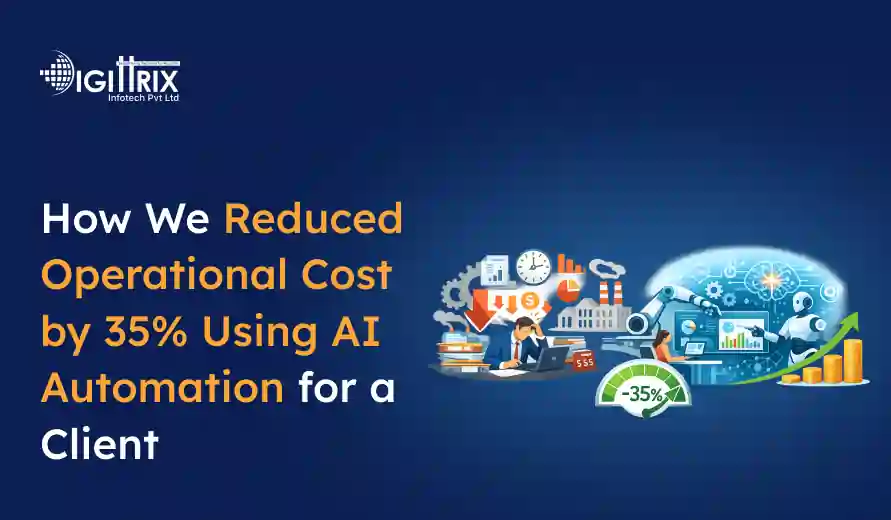
Many businesses still depend on manual work for daily tasks like data entry, document verification, customer queries, reporting, and request handling. As the workload grows, these repetitive tasks take up employee time and raise operational costs. In one of our recent projects, we helped a client cut operational costs by 35% by implementing AI automation for routine processes that were previously done manually.
Artificial Intelligence has become a practical solution for businesses that want to automate repetitive tasks and enhance operational efficiency. When AI systems are integrated with existing tools, companies can process information more quickly, minimize human errors, and manage larger workloads without adding staff.
At Digittrix, we assist businesses in implementing AI automation tailored to real operational needs. Our team starts by analyzing current workflows to pinpoint areas where automation can lessen manual effort. Typical automation opportunities include customer support chatbots, document data extraction, automated reporting tools, and workflow routing between departments.
We follow a structured approach that includes analyzing processes, choosing the right automation tools, organizing data, and conducting pilot implementations before scaling the system across operations. This method helps businesses implement AI smoothly without disrupting their existing processes.
If you want to cut down on manual work and boost operational efficiency, Digittrix can assist you in deploying effective AI automation solutions.
To learn how automation can cut operational costs for your business, contact Digittrix today.
Call +91 8727000867 or email hello@digittrix.com to get started with your automation journey.
2026 AI Automation Cost Reduction Roadmap
An AI automation cost-reduction project should start with measurable workflows, not a tool-first rollout. The strongest candidates are tasks that repeat daily, create delays, require manual copy-paste work, or need frequent status updates.
Case-study checkpoints
- Workflow audit: review support tickets, document checks, reporting routines, task routing, approvals, and manual follow-ups.
- Automation scope: decide which steps can be automated, which need human approval, and which should stay manual for quality or compliance.
- Data readiness: clean customer records, document types, support categories, report fields, task rules, and exception queues before launch.
- Rollout plan: run a controlled pilot, train users, review failed automation events, and improve rules before expanding across teams.
- ROI tracking: measure manual hours saved, response time, processing time, error reduction, user adoption, report usage, and cost per workflow.
GEO and AI-search clarity
For stronger search and AI visibility, this page should clearly explain AI automation case study, AI automation cost reduction, operational cost reduction, AI workflow automation, business process automation case study, AI automation ROI, implementation roadmap, human oversight, security, KPIs, and lessons learned.
For deeper planning, compare our AI business process automation guide, AI RPA business operations guide, business process automation services guide, and AI development services.

 FAQ's
FAQ's