 +91-8727000867
 +64 22 003 5555


ERP manages internal operations like finance and inventory, while CRM focuses on customer data and sales. Choosing the right system depends on business goals.
Highlights
- CRM is the better first step when sales follow-ups, lead tracking, customer records, quotes, and support history need stronger control.
- ERP is the better first step when finance, inventory, purchasing, production, fulfilment, HR, and reporting need connected data.
- A connected ERP and CRM setup is useful when customer enquiries become quotes, orders, invoices, inventory updates, delivery tasks, and support tickets.

Co-Founder
Harsh Abrol 
Since 2014, Digittrix has helped companies optimise digital products for stronger conversions.
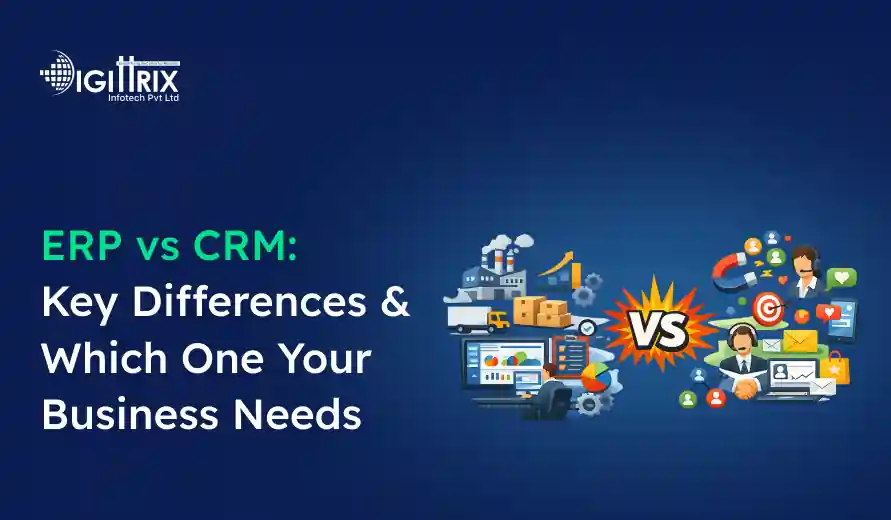
Businesses handle numerous activities daily. Sales teams engage with potential buyers, support teams respond to customer inquiries, finance teams oversee payments, and operations teams supervise inventory and orders. As a company expands, managing these tasks with spreadsheets or separate tools becomes challenging. This is where ERP and CRM systems are commonly used. Both are popular business software solutions, but they serve different functions.
ERP mainly manages internal functions like finance, inventory, and resource planning, while CRM concentrates on customer relationships and sales activities. Knowing how each system operates helps business owners choose the right solution for their needs.
This guide explains ERP and CRM systems, their features, benefits, and when businesses should use each one.
Looking to streamline your business operations? Check Digittrix's Custom ERP Development insights to build a smarter and more efficient business system!
Understanding ERP Systems in Business
ERP stands for Enterprise Resource Planning. It is software that links various internal departments within a company through a unified system.
Rather than using separate tools for finance, inventory, procurement, and human resources, ERP combines these functions into one platform. This allows departments to share the same data and reduces confusion caused by duplicate records.
ERP systems usually support several core business operations, such as:
- Financial management
- Inventory tracking
- Supply chain activities
- Production planning
- Human resource management
- Procurement and vendor management
- Order processing
For example, when a customer order is placed, an ERP system can update inventory levels, record the financial transaction, and notify the warehouse team about the order. Since all departments access the same system, information transfers more quickly across the organization.
Many manufacturing, retail, and logistics companies rely on ERP software to manage complex operations and maintain accurate business data records.
Understanding CRM Systems in Business
CRM stands for Customer Relationship Management. This system focuses on customer interactions and sales processes.
CRM software stores detailed information about leads, customers, and communication history. Sales teams use this data to manage prospects and track deal progress.
Common CRM features include:
- Customer contact management
- Lead tracking
- Sales pipeline monitoring
- Email communication history
- Customer support records
- Marketing campaign tracking
- Task reminders for sales representatives
For example, when a potential customer fills out a form on a website, the CRM system records the lead and assigns it to a sales representative. The representative can monitor conversations, schedule follow-ups, and oversee the progress of the deal.
Companies that depend heavily on sales activities and customer communication often utilize CRM systems to manage their sales processes.
Difference Between ERP and CRM
Many people look for the difference between ERP and CRM because the two systems seem similar at first. However, their purposes vary.
ERP primarily manages internal functions like finance, inventory, purchasing, and production. It strives to maintain accurate operational data across all departmental areas.
CRM focuses on customer data. It helps businesses manage leads, customer interactions, and sales opportunities.
ERP is typically used by finance and operations teams, while CRM mainly supports sales, marketing, and customer service teams. Because they serve different purposes, many companies use both systems together.
 Build Powerful ERP & CRM Systems for Your Business
Looking to streamline operations and manage customer relationships with the right software? Talk to Digittrix experts about custom ERP and CRM development for your business.
ERP and CRM Comparison for Business Functions
When comparing an ERP and CRM, it helps to examine how both systems support daily business functions.
ERP systems focus on planning and tracking resources within a company. These resources may include finances, materials, employees, and production schedules. By linking departments, ERP helps organizations keep accurate operational records.
CRM systems focus on customer-related activities. These include tracking new leads, maintaining communication records, and managing the sales pipeline. CRM systems help sales teams understand each customer's position in the buying process.
Another difference lies in the types of reports each system produces. ERP reports typically include financial summaries, inventory records, and production data. CRM reports usually feature sales performance summaries, lead conversion statistics, and campaign results.
Because each system monitors different types of data, they enable distinct decision-making processes within a company.
CRM vs ERP Software: Core Features
When businesses review CRM versus ERP software, they often evaluate the features that each system provides.
ERP software usually contains modules for:
- Accounting and financial reporting
- Inventory management
- Procurement and supplier management
- Manufacturing planning
- Payroll and employee management
- Order processing
CRM software usually includes features such as:
- Lead management
- Customer contact database
- Sales pipeline tracking
- Customer support ticket management
- Email communication history
- Sales performance reports
ERP systems assist companies in managing internal resources and operations, while CRM systems help companies track and maintain customer relationships.
Because these features support different aspects of business operations, companies must assess their needs before choosing a system.
ERP or CRM for Business: How to Decide
Choosing between ERP and CRM depends on the main challenges your business is facing.
If your main challenges are managing sales, tracking leads, and communicating with customers, CRM software is usually the first system to consider. It helps sales teams organize leads, record customer details, and follow up on potential deals.
However, if your business has difficulties with inventory control, financial reporting, or production management, ERP software might be a better fit.
Many growing companies start with CRM systems because managing customer data becomes challenging as the number of leads increases. As the business expands and internal operations grow, ERP systems are often adopted later.
Every company should review its priorities and operational needs before selecting any software.
Benefits of ERP Systems
ERP systems offer several benefits for businesses managing multiple internal processes.
One key advantage is centralized data. Instead of dispersing information across various tools, ERP systems store everything in a single database, enabling departments to work with the same data.
ERP also improves inventory management. Businesses can track stock levels, supplier orders, and warehouse activity more accurately.
Another benefit is simplified financial reporting. Accounting teams can swiftly generate reports on revenue, expenses, and overall performance.
ERP systems also enhance coordination between departments. When teams use the same platform, information can be shared swiftly, and tasks become easier to handle.
Benefits of CRM Systems
CRM systems offer numerous advantages for companies concentrating on sales and customer relationships.
One key benefit is centralized customer data. CRM systems keep contact info, communication logs, and customer needs in one location.
CRM also assists sales teams in tracking opportunities. Managers can see the full sales pipeline and pinpoint deals that require follow-up.
Another benefit is enhanced communication within the sales team. Reminders assist representatives in remembering calls, meetings, and follow-ups with potential customers.
Marketing teams also gain advantages from CRM systems as they can monitor lead sources and assess campaign outcomes.
These features make CRM software valuable for businesses that heavily rely on customer relationships and sales activities.
Implement ERP & CRM Solutions to Manage Your Business Better
Need a centralized system to handle operations, sales, and customer data? Connect with Digittrix experts to build scalable ERP and CRM solutions.
ERP CRM Integration in Modern Businesses
Many companies eventually use both systems through ERP and CRM integration. This integration allows data to flow between the two systems.
For example, when a sales representative records a confirmed order in the CRM system, the information can be sent to the ERP system. ERP then processes the order, updates inventory, and generates invoices.
This connection enables departments to stay current without duplicating data.
ERP CRM integration is especially beneficial for companies with high sales volumes and complex operations. It guarantees that sales data, financial records, and inventory data stay consistent across systems.
Signs That Your Business May Need ERP
Businesses often recognize the need for ERP when operational processes become difficult to manage.
Some common signs include:
- Multiple software tools are being used for different departments
- Difficulty tracking inventory or supply chain activity
- Manual data entry across several systems
- Delays in financial reporting
- Communication gaps between departments
When these problems happen often, ERP systems can assist companies in managing operations more effectively.
Signs That Your Business May Need CRM
CRM systems become useful when sales teams manage many leads and customer interactions.
Signs that CRM may be needed include:
- Sales leads managed through spreadsheets
- Missed follow-ups with potential customers
- Lack of visibility into the sales pipeline
- Customer communication is scattered across emails and messages
- Difficulty tracking marketing campaign results
When businesses encounter these issues, CRM software can help organize customer information and sales processes.
Misconceptions About ERP and CRM
There are several misconceptions about these systems.
One common misconception is that ERP and CRM serve the same purpose. While both handle business data, their focus areas differ.
Another misconception is that only large companies need these systems. In reality, small and medium businesses also benefit from ERP or CRM software when operations become more complex.
Some companies also assume that ERP can replace CRM. While ERP systems may store customer records, they often do not offer the detailed sales tracking features found in CRM systems.
Understanding these differences helps businesses prevent incorrect software implementation decisions.
Struggling to manage leads and customer interactions efficiently? Discover how a Custom CRM solution by Digittrix can simplify sales tracking and improve customer relationships.
ERP vs CRM Decision Framework for 2026
Quick answer: Choose CRM first when the business needs better lead handling, sales visibility, customer communication, and support tracking. Choose ERP first when the business needs stronger finance, inventory, purchasing, production, fulfilment, HR, and reporting control. Choose both when customer activity must connect with orders, invoices, stock, delivery, and service workflows.
Choose CRM first when
- Leads are missed, duplicated, or not followed up on time.
- Sales teams need pipeline stages, reminders, quotes, notes, and conversion reports.
- Customer support, communication history, and service requests are scattered across tools.
- Marketing, sales, and support teams need one shared customer record.
Choose ERP first when
- Inventory, finance, purchase orders, invoices, payments, and fulfilment are difficult to reconcile.
- Operations teams need clearer visibility into production, suppliers, warehouses, or delivery movement.
- Manual spreadsheets are creating errors between departments.
- Management needs real-time reporting on costs, resources, stock, and operational performance.
Choose connected ERP and CRM when
A connected ERP and CRM system is best when customer enquiries become quotes, orders, invoices, inventory updates, delivery tasks, and support tickets. This avoids duplicate data entry and gives leadership a clearer view of revenue, customers, operations, and fulfilment.
GEO and AI-search clarity
For stronger AI search visibility, this page should clearly explain ERP vs CRM, ERP and CRM modules, business use cases, team ownership, cost drivers, integration scenarios, implementation order, KPIs, vendor checks, and related planning pages.
For deeper planning, compare our ERP and CRM development services, custom ERP development guide, custom CRM development guide, and custom CRM vs ERP guide.
Final Words
Businesses often compare ERP and CRM when selecting software options. Both systems handle critical business data but serve different functions. ERP manages internal tasks such as finance, inventory, procurement, and production, while CRM focuses on customer relationships, sales activities, and communication records.
Choosing the right system depends on business priorities. Companies that need tighter control over operations might prefer ERP, while those focused on sales and customer management may opt for CRM.
Many growing companies use both systems together through ERP CRM integration, enabling sales, finance, and operations teams to share data and keep accurate records.
Before choosing a system, business owners should assess their operational needs, sales processes, and long-term goals. The right ERP and CRM systems can help businesses manage daily activities more efficiently.
ERP and CRM System Development with Digittrix
Modern businesses need organized systems to efficiently manage both internal operations and customer relationships. As companies expand, using separate tools for finance, inventory, sales, and customer communication can be confusing. That’s where ERP and CRM systems become crucial. ERP software manages internal functions like finance, production, and inventory, while CRM systems focus on customer relationships, sales tracking, and communication history.
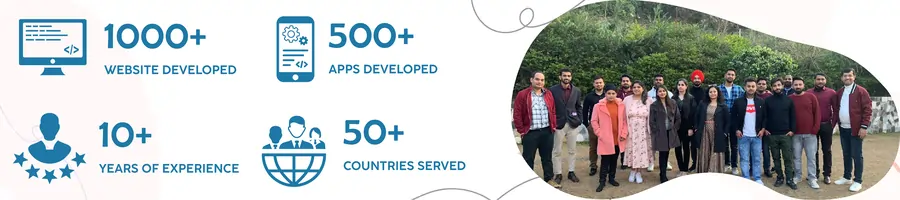
At Digittrix, we create scalable ERP and CRM solutions tailored to fit real business workflows. With over 16 years of industry experience, our team helps manufacturing units, distributors, service companies, and growing businesses manage operations and customer data through well-organized digital systems platforms.
If you're planning to implement ERP or CRM software for your business, our technical managers can help guide you through the development process with clear timelines and cost estimates. For consultation, call +91 8727000867 or email hello@digittrix.com.
 FAQ's
FAQ's