 +91-8727000867
 +64 22 003 5555


Highlights
- 40% improvement may come from regular parking practice and repeated manoeuvres.
- 35% better spatial judgement may develop through consistent mirror and visual checks.
- 30% greater parking confidence may come from regularly practising in quiet areas.

Co-Founder
Harsh Abrol 
Since 2014, Digittrix has helped companies optimise digital products for stronger conversions.
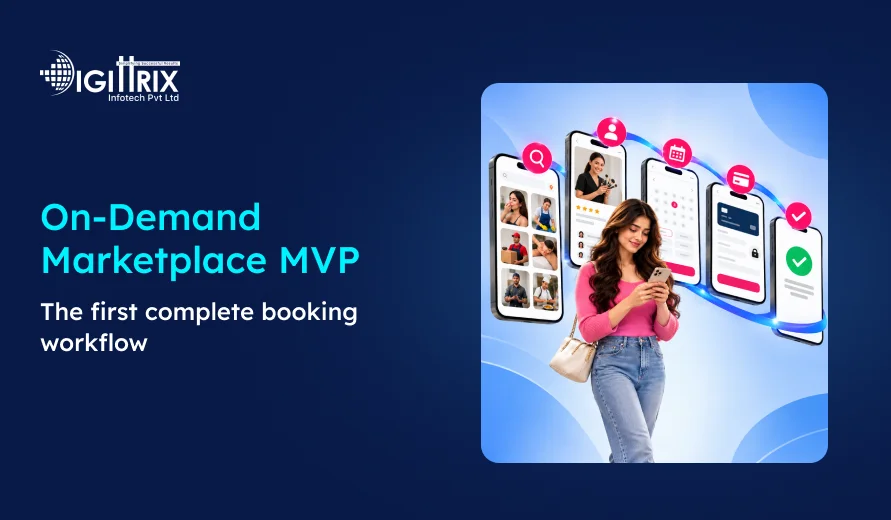
An on-demand marketplace lives or dies on one question: can an order travel from a customer's phone to their doorstep without someone fixing it by hand? Many founders start with offers, loyalty points, recommendations and three cities. A stronger first version does one job completely, for one group of customers, in one area.
This guide walks through what that first job looks like. Grocery is the worked example because it has the most moving parts, but the same thinking applies to service booking and other on-demand models. Good app development services start from the workflow the business can actually run, not from a feature list.
Planning a moving app? Check Digittrix's Moving App MVP insights to plan booking, customer, crew, and admin features!
What an On-Demand Marketplace MVP Includes
An on-demand marketplace MVP is the first working version of a platform where customers find something, place an order or request, pay, and follow its progress. It usually connects three sides: the customer, the provider (a store or service professional), and the admin team that runs the platform.
Grocery adds two more roles. A picker prepares the items and a delivery partner completes the last mile. The goal is not to launch every feature. It is to test one complete journey with real customers and real providers before the platform grows.
 Build a Smart Grocery & On-Demand Marketplace App
Planning a grocery or on-demand marketplace? Talk to Digittrix experts about your app development needs.
The Customer Side: Fewer Steps Between Search and Checkout
Customers judge the product on how quickly they can get from "I need milk" to "it's on the way." A good first version covers:
- Account and addresses. A short sign-up, with saved addresses and order history.
- Discovery. Categories, search and filters that still work when the catalog has thousands of items.
- Cart. Editable quantities, variations, prices, charges and a clear total.
- Address and slot. Delivery slots should match what the store, warehouse or fleet can actually handle. A slot the business can't honour is worse than no slot.
- Checkout. A payment gateway suited to the market, with clear handling of failed payments so the order status never becomes ambiguous.
- Tracking and notifications. Status updates from the moment the order is placed.
Grocery makes this harder than general retail. Products are sold by weight or pack size, availability changes through the day, and shoppers expect to approve substitutions. That is where shopping app development for a supermarket differs from a typical fashion or electronics store. Grocery shopping app development has to treat a "sold out" item as a normal event, not an error.
Behind the Order: Store, Picker, Delivery and Admin
Once the customer pays, the order becomes an operations problem. It moves through a chain like this:
Order Placed → Accepted → Preparing → Ready → Out for Delivery → Delivered
The exact stages depend on how the business fulfils orders. Each stage needs the right tool in the right hands:
- Store or vendor panel. Manages the catalog, prices, stock and incoming orders, and accepts or rejects requests.
- Picker or warehouse panel. Provides pick lists, quantity and barcode checks, substitution requests, packing and dispatch readiness. It is only needed when picking is handled separately from the store.
- Delivery partner app. Shows assignments, navigation, customer contact, status updates, proof of delivery and issue reporting.
- Admin panel. Gives the business control over customers, stores, service zones, orders, payments, refunds, staff permissions and reports. It is also where exceptions such as cancellations and support cases are handled.
Choosing the Right Business Model
The same customer journey needs very different back-end work depending on who owns the inventory and who delivers. Getting this decision right early prevents expensive rework later.
|
Model |
Best suited to |
What changes in the build |
|
Single store |
Independent grocers and specialty retailers |
Branded catalog, inventory, pickup or delivery slots, store administration |
|
Multi-store chain |
One retailer with several branches |
Location-based catalogs, branch inventory, order routing, central reporting |
|
Multi-vendor marketplace |
Platforms that onboard independent stores |
Vendor onboarding, separate catalogs, commissions, order allocation |
|
Hyperlocal / quick commerce |
Fast delivery within defined zones |
Live availability, store or hub assignment, dispatch, real-time tracking |
|
B2B wholesale |
Businesses buying in bulk |
Account pricing, minimum quantities, approval flows, invoices, repeat orders |
This is where app development services earn their place. A ready-made template rarely fits a business with its own delivery rules, branch structure or vendor commissions, and a workflow shaped around how you actually operate is easier to run. Likewise, grocery app development for a quick-commerce start-up has little in common with a single kirana store, even though both sell groceries. And online grocery app development for a chain may need a responsive web store and mobile apps sharing one catalog and one back end.
 7-Day Risk Free Start
Start Your 7-Day Free Trial With Proven Experts
If this article sparked a project idea, start with a dedicated expert for 7 days at no risk. Continue at just $10/Hour if the collaboration is the right fit for your business.

Dedicated Expert Access
Work directly with a specialist aligned to your project goals and timeline.

Direct Chat with Your Team
Collaborate in real-time and get instant support.

Screenshots & Reports
Receive regular reports to track progress transparently.

No Contracts
No commitments. Cancel anytime, no hassle.

Limited Slots Available This Week!
Kickstart Your Project With Zero Risk And Total Confidence.


& Growing Brands
Which Apps Do You Actually Need First?
Not every role needs its own app on day one. Mobile application development works best when each app has a clear reason to exist:
- Customers almost always need a mobile app or a responsive web store.
- Delivery partners need a mobile app because they work on the move.
- Store and picker teams can often start with a web-based panel on a tablet or laptop.
- The admin panel is normally web-based.
Decide this from your operating model. Building separate apps that the first release does not need adds cost and testing without adding learning.
What to Leave for Later
A first release should prove that ordering and fulfilment work. These can wait until you have real data, integrations and operational capacity:
- Offers, loyalty programs and referrals
- Recurring orders and recommendations
- Advanced analytics and demand forecasting
- POS and ERP synchronization
- Real-time stock sync and route planning
- Multi-store and multi-vendor controls, if you start with a single store
Each of these depends on something the MVP is meant to produce: order history, reliable stock data or stable operations.
Integrations and Technology
A marketplace usually combines mobile apps, responsive web interfaces, backend APIs, a database and cloud hosting with third-party services. The common integrations are:
- Payment gateways
- Maps and GPS
- SMS, WhatsApp and push notifications
- Inventory, POS or ERP systems, where compatible APIs exist
For each integration, agree who owns the data, how often it syncs, what happens when it fails, and what the fallback is. Confirm the final technology choices for mobile app development only after the scope and integrations are clearly defined.
Build a Smart Grocery & On-Demand Marketplace App
Planning a grocery or on-demand marketplace? Talk to Digittrix experts about your app development needs.
Planning and Testing the First Release
A practical sequence looks like this:
- Fix the business model and launch area. One store, one zone or one vendor group is enough.
- Name every user role, including pickers and delivery partners.
- Map the full journey, from discovery through payment, fulfilment, delivery and refund.
- Choose only the features that journey needs, and list the integrations that support them.
- Design the screens for each role around that agreed flow.
- Test the failures, not just the happy path. Try payment failures, unavailable products, substitutions, cancellations, late deliveries and refund requests.
- Launch in the agreed area and let real feedback decide what to build next.
Most launch problems appear in step 6. An order that works when everything goes right tells you little about how the platform behaves on a busy evening.
What Does It Cost?
Cost depends on the number of apps, user roles, platforms, integrations, data migration and support. A single-store grocery app is a much smaller project than a multi-vendor marketplace with separate vendor, picker, delivery, customer and admin workflows.
For reference, Digittrix's published grocery planning tiers are:
- A defined grocery delivery package at ₹75,000, typically delivered in about three weeks
- Multi-store grocery apps from ₹1.5 lakh, typically six to eight weeks
- Marketplace or quick-commerce platforms from ₹2.5 lakh, with the timeline confirmed after discovery
GST and hosting are separate, and the signed proposal confirms the final scope and price. Whichever provider you choose, ask app development services teams to state in writing what is included: applications, features, integrations, platforms, data migration, third-party costs, hosting, support, code ownership and milestones. A clear scope makes budgets easier to compare and prevents surprises later. You can see the full breakdown on the grocery app development page.
Building a restaurant ordering app? Check Digittrix's Restaurant Ordering App MVP insights to plan menu, cart, checkout, and admin features!
Final Words
Building an on-demand marketplace starts with defining a complete and practical workflow. Customer ordering, product or service discovery, cart, checkout, payments, provider management, fulfilment, delivery, notifications, and admin controls can form the foundation of the first release.
A focused MVP allows businesses to test their marketplace with real users and understand which features are needed as the platform grows. Whether the business is planning a grocery platform, shopping application, or another on-demand marketplace, the development scope should match its business model, users, and daily operations.
A clear workflow and well-planned features can help create an application that is simple for customers to use and easier for businesses to manage.
Start With One Workflow You Can Run
The strongest marketplaces begin small and complete: a defined area, a clear set of roles, and an order that moves from discovery to delivery without manual repair. Once that works, new categories, locations, vendors and integrations have a solid base to grow on.
If you are planning a grocery ordering platform or another on-demand marketplace, define the scope and operating model before the build starts. Digittrix can walk through the customer, store, picker, delivery and admin workflows with you and cover mobile apps, web interfaces, backend, payments, maps, notifications and agreed integrations.
Call +91 8727000867 or email digittrix@gmail.com to discuss your requirements.
 FAQ's
FAQ's