 +91-8727000867
 +64 22 003 5555


Highlights
- Choose essential educational app features based on your audience and learning goals.
- Compare technology options, development costs, and revenue models before starting.
- Test learning functions, protect user data, and track results after launching your app.

Co-Founder
Harsh Abrol 
Since 2014, Digittrix has helped companies optimise digital products for stronger conversions.
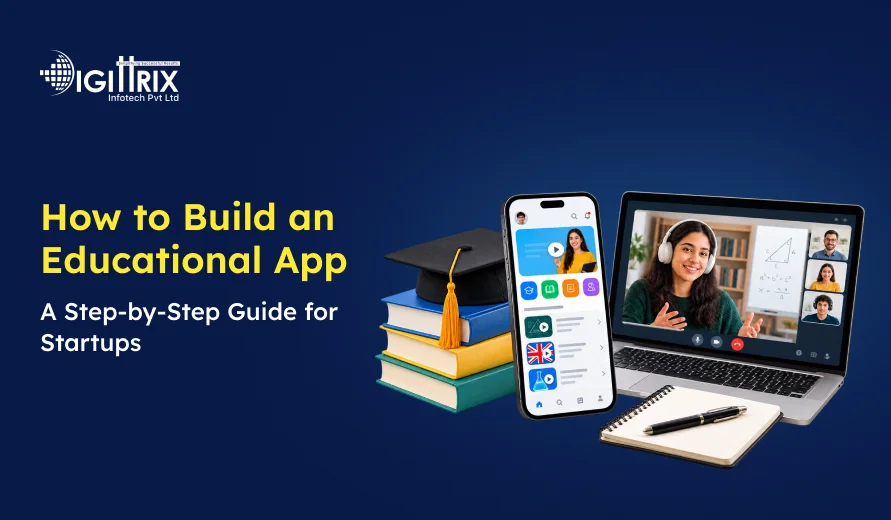
Building an educational app starts with a clear learning problem, a defined audience and a manageable first release. Understanding how to build an educational app means deciding what learners need, which features are essential, how content will be delivered and how success will be measured. Startups should validate these decisions before committing to a large development budget.
An educational app MVP (minimum viable product) is an initial version built around the smallest set of features needed to test a learning idea. It helps founders collect feedback from actual users before investing in advanced functionality, additional courses or complex integrations.
This guide covers educational app development steps, MVP feature planning, cost considerations, accessibility, privacy, testing and launch measurement.
Want to build an education app that students actually use? Check Digittrix's education app development insights to improve student engagement!
1. Define the Learning Problem Before Development
Before deciding how the app should look or which technology it should use, identify the learning problem it will solve.
An education app development for school students may need lessons, quizzes and teacher feedback. A professional training app may require structured modules, progress reports and completion certificates. A tutoring platform may need class scheduling, communication tools and session records.
Define these points before development:
- Target audience: Identify the learner age group, skill level, location and device preferences.
- Learning objective: Specify what users should understand or be able to do after completing a lesson or course.
- Delivery format: Decide whether content will include videos, live classes, text lessons, quizzes or downloadable resources.
- Access requirements: Determine whether users need offline access, multiple languages or support for low-bandwidth connections.
- Success criteria: Set measurable goals, such as lesson completion, assessment performance or returning learners.
For example, a startup creating an app for exam preparation could begin with one subject, a limited question bank and progress tracking. It does not necessarily need live classes, social features and AI tutoring in its first release.
2. Validate the Idea With Learners and Educators
Market validation helps founders test whether the proposed app addresses a real need. It should happen before substantial development spending.
Interview potential learners, parents, teachers or training managers. Ask how they currently study, which tasks cause difficulty and what they would expect from a new app. Review competing products to identify common features, pricing models and gaps in their learning experience.
A practical validation process includes:
- Interview a small group of representative users.
- Document their most frequent learning challenges.
- Create a simple prototype showing the proposed learner journey.
- Ask users to complete common tasks with the prototype.
- Record confusing steps, missing information and repeated requests.
- Revise the MVP scope before approving development.
Avoid relying only on positive feedback about the idea. Observe whether people can complete the intended tasks and whether the proposed solution fits their learning routines.
 Build a Smart Educational App for Your Business
Planning an educational app? Talk to Digittrix experts about MVP features, learning content, development costs, accessibility, and launch planning.
3. Prioritise Education App Features for the MVP
Choosing education app features should follow the learning objective rather than a desire to match every competitor. A smaller feature set is easier to test, explain to users and maintain after launch.
Common MVP features include:
- Learner registration and secure login
- Course or lesson catalogue
- Lesson viewing and learning materials
- Quizzes or basic assessments
- Learner progress tracking
- Notifications for relevant learning activities
- An administration panel for managing content
- Basic support or feedback options
Additional features, such as live classes, AI recommendations, advanced analytics, gamification and third-party integrations, can be considered after the initial product has been validated.
Define acceptance checks for every core feature
A feature description tells the development team what to build. An acceptance check explains how the founder will decide whether the feature is ready.
|
MVP feature |
Example acceptance check |
|
Registration |
A new user can register with valid details and receives a clear message if required information is missing. |
|
Lesson catalogue |
A learner can view available lessons and open a lesson they are authorised to access. |
|
Video lesson |
A supported video plays, displays its controls and reports a useful error if playback fails. |
|
Quiz |
The app records submitted answers and displays the score according to the agreed rules. |
|
Progress tracking |
Completing a lesson updates the learner's progress and preserves it after signing out and back in. |
|
Admin content management |
An authorised administrator can create, edit and publish a lesson without access to unauthorised account data. |
These checks should be agreed upon before development begins. They give the founder and development team a shared definition of completion and reduce disagreements during acceptance testing.
Learn from an existing education app project
The Dudar Teacher Calling App case study can be reviewed as an example of an education-related application project. Use case studies to identify relevant project considerations, but do not assume that another product's features, outcomes or technical choices will automatically suit your MVP.
4. Choose a Suitable Business Model
The business model affects feature planning, payment workflows and ongoing operating costs. Select a model that fits the audience and the value the app provides.
Common options include:
-
Subscription: Users pay monthly or annually for access to courses or learning tools.
-
One-time purchase: Learners pay for an individual course, resource or programme.
-
Freemium: Basic learning materials are free, while selected content or functionality requires payment.
-
Institutional licensing: Schools, colleges or companies pay for access for their learners.
-
Tutoring fees: Users pay for individual sessions or scheduled classes.
Before selecting a model, test willingness to pay and calculate the cost of content creation, instructor time, payment processing, support and platform maintenance. If the app serves minors, payment and account workflows should also account for the relevant audience and applicable requirements.
 7-Day Risk Free Start
Start Your 7-Day Free Trial With Proven Experts
If this article sparked a project idea, start with a dedicated expert for 7 days at no risk. Continue at just $10/Hour if the collaboration is the right fit for your business.

Dedicated Expert Access
Work directly with a specialist aligned to your project goals and timeline.

Direct Chat with Your Team
Collaborate in real-time and get instant support.

Screenshots & Reports
Receive regular reports to track progress transparently.

No Contracts
No commitments. Cancel anytime, no hassle.

Limited Slots Available This Week!
Kickstart Your Project With Zero Risk And Total Confidence.


& Growing Brands
5. Estimate Educational App Development Cost Before Starting
Educational app development cost varies according to product scope, design complexity, platform choice, integrations, content requirements and testing needs. A basic course library generally requires less work than an app with live classes, complex assessments, personalised recommendations and several administrative roles.
Prepare a budget covering more than the initial build:
- Product discovery and requirements
- User interface and experience design
- Mobile app or web development
- Backend systems and database setup
- Learning content creation and licensing
- Third-party services and integrations
- Quality assurance and accessibility testing
- Hosting, maintenance and technical support
Request an itemised estimate that separates included features from exclusions, assumptions, recurring fees and additional-work rates. Ask the provider to identify which deliverables will be available at each milestone.
For education mobile app development, also consider whether the first release needs both iOS and Android apps or whether a responsive web product can validate demand before additional platforms are built.
For current development options and package information, visit Digittrix’s education app development services.
6. Select the Technology Stack Based on Product Needs
The technology stack should reflect the app's expected usage, team capabilities, integrations and maintenance requirements. There is no single stack that suits every educational product.
A startup may choose native mobile development when it needs platform-specific functionality. Cross-platform development may be appropriate when the team wants to share more code between iOS and Android. A web application may be sufficient when learners mainly use browsers or when rapid validation is the immediate priority.
Evaluate the following before making a decision:
- Supported devices and operating systems
- Expected user numbers and traffic patterns
- Video delivery and storage requirements
- Integration with payment, identity or learning systems
- Security and access-control needs
- Availability of developers for future maintenance
- Cost of hosting, updates and third-party services
Document the reason for each major technology choice. This makes future changes easier to assess and prevents the product from becoming dependent on tools that the team cannot maintain.
7. Design an Accessible and Easy-to-Use Learning Experience
The interface should help learners find lessons, understand progress and complete activities without unnecessary steps. Use clear navigation, readable text, consistent buttons and visible feedback when users submit answers or complete tasks.
Use WCAG 2.2 to inform applicable web accessibility requirements, and combine automated checks with keyboard and screen-reader testing.
Test common tasks on different screen sizes and devices. Check whether learners can access lessons, submit assignments, understand error messages and resume interrupted activities without confusion.
Consider captions or transcripts for video lessons, meaningful labels for form controls, sufficient text contrast and clear focus indicators. Where learners may have limited internet access, assess whether compressed media, downloadable resources or a low-bandwidth mode would support their needs.
Build a Smart Educational App for Your Business
Planning an educational app? Talk to Digittrix experts about MVP features, learning content, development costs, accessibility, and launch planning.
8. Develop the App and Prepare Learning Content
Development includes building the learner-facing interface, backend services, data structures, administration tools and required integrations. Content preparation should happen alongside technical work so that the product can be tested with realistic lessons and assessments.
A practical workflow is:
- Confirm requirements and user journeys.
- Approve wireframes or interface prototypes.
- Build the highest-priority MVP features.
- Prepare and upload initial learning materials.
- Connect required services and integrations.
- Test the product against agreed acceptance checks.
- Fix issues and prepare the release.
When evaluating an education app development company, ask for a clear scope, milestone-based deliverables, testing responsibilities, documentation and post-launch support terms. Request examples of comparable work where available, and ask how the team handles changes that fall outside the agreed scope.
Avoid approving a proposal based only on its headline price. The included features, ownership of source code, maintenance arrangements and acceptance process are also important.
9. Test Security, Privacy and Core Workflows
Before release, test account creation, login, lesson access, progress tracking, assessments, payments where applicable, notifications and administrative controls. Combine automated tests with manual checks on supported devices.
Review what personal data the app collects, why it is needed, who can access it, how long it is retained and how users can raise privacy requests. Consult the official MeitY Digital Personal Data Protection Rules, 2025 resource. Have a qualified privacy or legal professional confirm which provisions and commencement dates apply to the product and its audience.
Document test results, unresolved issues and release approval before making the app available to learners.
10. Launch the MVP and Measure Learner Activity
Launch with a defined audience and a manageable set of learning materials. A limited rollout can reveal usability problems before a wider release.
Track metrics that connect to the app's learning purpose:
- Lesson completion rate: The percentage of learners who start a lesson and complete it during the defined measurement period.
- Returning learners: The number or percentage of users who return within a specified period, such as seven or thirty days.
- Assessment performance: Scores or completion rates for quizzes and tests.
- Course progression: The percentage of learners who move from one course stage to the next.
- Support requests: The number and type of issues learners report.
- Technical failures: Failed logins, playback errors, crashes or unsuccessful submissions.
Define how each metric is calculated before comparing results. For example, returning learners should be measured over the same time window for each reporting period. A high number of downloads alone does not show whether learners are using the app or completing lessons.
For user acquisition, consider how prospective learners will find and evaluate the product. Digittrix's article on how online education marketing helps schools and colleges reach more students discusses the marketing side of reaching education audiences.
Use learner feedback and product data to decide which feature or problem should be addressed next. Avoid adding new functionality until the team understands the main reasons users are struggling or leaving.
Founder Checklist Before Approving the MVP
Use this checklist before committing to development or approving the first release.
- The target learner and learning problem are clearly defined.
- The core learning outcome can be explained in one or two sentences.
- User interviews or prototype testing have informed the feature list.
- Each MVP feature has an agreed acceptance check.
- The initial budget includes development and ongoing operating costs.
- The technology choices match the product's actual needs.
- Accessibility checks and supported-device requirements are documented.
- Data collection, access permissions and retention practices have been reviewed.
- Testing responsibilities and release approval criteria are assigned.
- Success metrics have clear definitions and measurement periods.
Want to reach more students online? Check Digittrix's online education marketing insights to help schools and colleges connect with more students!
Final Words
Building an educational app requires clear goals, market research, suitable features, appropriate technology, quality learning materials, and careful testing. Start with a focused product, gather feedback from actual users, and use their experiences to guide future improvements.
For startups evaluating How to Build an Educational App, software quality and the learning experience deserve equal attention. Choose a development partner with a clear project scope, transparent pricing, a defined testing process, and written support terms. A well-planned first release can provide a sound starting point for a sustainable education business.
Plan Your Educational App MVP With Digittrix
Planning an educational app MVP? Explore Digittrix's education app development services for delivery options, project examples, and current package information. Prepare your learner audience, essential workflows, and integration requirements before requesting a scoped proposal.
To discuss your requirements, submit your project enquiry. Contact Digittrix today at +91 8727000867 or at hello@digittrix.com to discuss your educational app development project and business goals.
 FAQ's
FAQ's