 +91-8727000867
 +64 22 003 5555


Highlights
- 62% of student enrollments in India now come through digital channels, indicating wider reach.
- 43% of online students first use college websites when researching and comparing programs.
- 71.78% of student leads come from digital channels, making online outreach essential to recruitment.

Co-Founder
Harsh Abrol 
Since 2014, Digittrix has helped companies optimise digital products for stronger conversions.
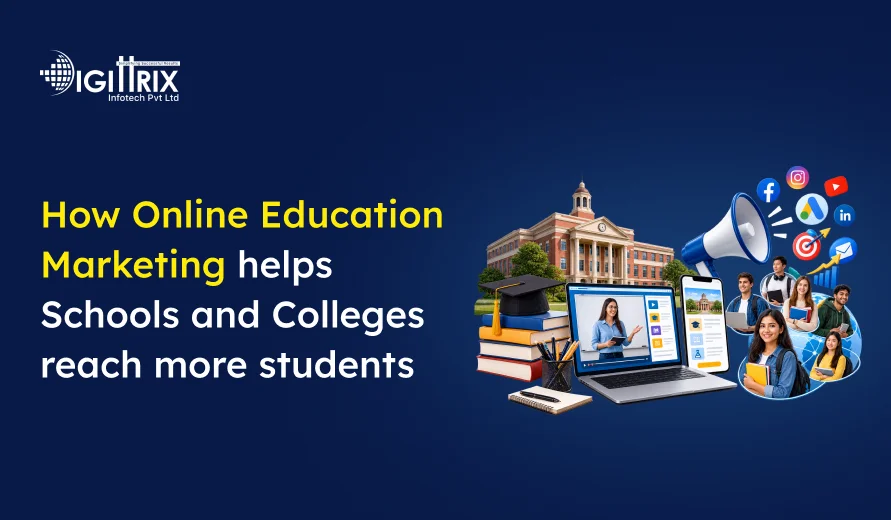
Today, students and parents use the internet to compare schools, colleges, courses, fees, facilities, admission requirements, and career opportunities before making an education decision. Online Education Marketing helps educational institutions reach these audiences through search engines, websites, social media, useful content, email, online advertising, and other digital channels. Instead of depending only on traditional promotions, schools and colleges can communicate with prospective students when they are actively looking for information. A clear digital approach can help an institution attract relevant visitors, answer their questions, build trust, and guide them toward an enquiry or application.
Looking to attract more students? Check Digittrix's Digital Marketing for Educational Institutions insights to support student enrolments and sustainable growth!
Why Online Education Marketing Matters for Schools and Colleges
The way students search for educational opportunities has changed significantly. A student interested in a particular course may first search Google for colleges offering that program. Parents may look for information about fees, academic performance, safety, facilities, faculty members, and student support. International students may search for admission requirements, accommodation, scholarships, and application procedures.
This makes visibility on digital platforms important for educational institutions.
A school or college with limited online information can miss potential enquiries even if it provides good academic programs. Students may simply choose another institution because its website provides clearer answers or appears more often in search results.
Online Education Marketing gives institutions several opportunities to communicate with prospective students. A well-organized website can provide course details, while search engine optimization can help those pages appear for relevant searches. Social media can show campus activities, and email can keep interested students updated about important dates.
The main objective should not be to promote the institution everywhere without a clear plan. Instead, every digital activity should provide useful information and make it easier for students to understand what the institution offers.
Building a Website That Supports Student Decisions
A website is often one of the first places a prospective student visits after finding an institution online. It should therefore provide accurate information in a simple format.
Important website sections may include:
-
Courses and programs
-
Admission requirements
-
Tuition and other fees
-
Scholarships
-
Faculty information
-
Campus facilities
-
Student activities
-
Career and placement information
-
Application instructions
-
Contact details
-
Frequently asked questions
Course pages deserve particular attention. A page should explain the program duration, eligibility criteria, subjects, learning format, admission process, possible career paths, and other important details.
For example, a college offering a Bachelor of Business Administration program can create a dedicated page explaining the course structure, eligibility, admission process, expected duration, available specializations, and possible career options.
Clear pages help students find answers without having to contact the institution for every basic question.
Online Education Marketing and Search Engine Visibility
Search engines are an important part of the student research process. People use searches such as "best colleges for computer science," "schools near me," "MBA admission requirements," and "online degree courses."
Search engine optimization can help educational websites appear when potential students make these searches.
Institutions can create useful pages around individual courses, departments, locations, admission topics, and student services. Instead of placing every detail on one page, information can be divided into focused sections that answer specific questions.
For example, a college can create separate pages for its undergraduate programs, postgraduate programs, scholarships, admission process, campus facilities, and career services.
Keyword research can help identify what students are searching for. However, keywords should be used naturally. A page filled with repeated phrases may be difficult to read and may not provide a good experience for visitors.
Good search visibility comes from combining relevant topics with useful, accurate, and well-structured information.
Education Marketing Strategies That Support Student Enquiries
Different students respond to different forms of communication. Some prefer reading detailed course information, while others may respond better to videos, social media posts, or direct communication.
 Grow Student Enquiries with Online Education Marketing
Looking to attract more students and improve admissions? Talk to Digittrix experts about education marketing today.
Several Education Marketing Strategies can work together as part of a broader digital plan.
Content marketing can answer questions about admissions and courses. Social media can highlight student activities and campus events. Paid advertising can reach specific audiences. Email can provide reminders and updates to students who have already shown interest.
The institution should connect these activities rather than treating each channel as completely separate.
For instance, a blog article about choosing a particular degree can link to the relevant course page. That course page can provide an enquiry form. After an enquiry, an email sequence can provide additional information about admission dates and application requirements.
This creates a clear path from information gathering to enquiry.
Digital Marketing for Schools Can Reach Parents and Students
Schools often need to communicate with both students and parents. Their concerns may be different, so the content should address both audiences.
Parents may want information about academic standards, safety, teaching methods, fees, transportation, facilities, and student welfare. Students may be more interested in activities, sports, technology, subjects, friendships, events, and the overall school experience.
Digital Marketing for Schools can address these interests through different types of content.
A school website can publish detailed information about its curriculum and facilities. Social media can show school activities, competitions, celebrations, projects, and approved student achievements. Videos can provide virtual campus tours or introductions from teachers.
Local search visibility can also be important for schools because families often search for institutions within a practical travel distance.
Providing accurate location information, admission details, contact information, and school facilities can help families make informed comparisons.
College Digital Marketing and Course Promotion
Colleges often have a wider range of programs and may need to communicate with different student groups. Undergraduate students, postgraduate applicants, working professionals, and international students can have very different requirements.
College Digital Marketing can help institutions create separate campaigns and content for these audiences.
A college could promote an undergraduate program through educational articles, social media content, videos, and search advertising. At the same time, a postgraduate program could have its own landing page with information about eligibility, entrance requirements, course duration, specialization options, and career opportunities.
This level of segmentation makes the information more relevant.
College websites can also use landing pages for specific campaigns. If an advertisement promotes a particular course, the visitor should be sent directly to a page about that course rather than being sent to a general homepage.
Student Recruitment Marketing Through Useful Content
Students rarely make an education decision after seeing one advertisement. They may visit several websites, compare courses, speak with family members, check reviews, and return to the same websites several times.
Student Recruitment Marketing can support this longer decision-making process by providing useful information at different stages.
Early-stage content can introduce courses and career options. Comparison guides can help students understand differences between programs. Admission content can explain application requirements. Testimonials and student stories can provide information about campus life.
Useful content should answer real questions instead of simply repeating promotional statements.
For example, an institution can publish an article explaining what students should consider before choosing a computer science degree. The article can discuss course subjects, practical projects, career possibilities, study format, and factors students should compare between institutions.
The content can then direct readers to relevant course pages.
Grow Your Business Without Marketing Overload with Our 1 Week Plan

Social Media Management

CRM

SEO

Website Maintenance

Get 7 days free
With experts handling Content, CRM, SEO, and Website Maintenance —no contracts, no upfront cost.


Limited free trial slots available — start your 1-week growth plan today

Education Lead Generation From Digital Channels
Getting website visitors is only one part of digital marketing. Schools and colleges also need ways to turn interested visitors into enquiries.
Education Lead Generation can include enquiry forms, application forms, consultation requests, campus visit registrations, webinar registrations, downloadable admission guides, and other appropriate contact options.
Forms should ask for information that is genuinely needed. A long form with too many questions may discourage students from completing it.
Calls to action should also be clear. Instead of using vague wording, a course page might provide options such as "Request Course Information," "Book a Campus Visit," or "Apply Now," depending on the stage of the admission process.
Tracking enquiries can help institutions understand which courses, pages, campaigns, and channels are generating interest.
Using Social Media to Show Campus Life
Social media provides schools and colleges with an opportunity to show experiences that are difficult to communicate through standard website text.
Content can include:
-
Campus tours
-
Student projects
-
Faculty introductions
-
Sports activities
-
Cultural events
-
Workshops
-
Competitions
-
Graduation events
-
Alumni stories
-
Student achievements
Short-form videos can provide quick views of campus facilities and activities. Longer videos can explain courses, admission procedures, or student experiences in greater detail.
Authenticity matters. Institutions should use genuine photographs, videos, testimonials, and information rather than creating unrealistic expectations.
Regular posting also helps keep the institution visible to people who may be considering their options over several months.
Online Student Recruitment Across Different Platforms
Students do not use just one digital channel when researching education. One person may find a college through Google, visit its website, watch a video on YouTube, check its social media profile, and later return through a search advertisement.
Online Student Recruitment therefore works best when different channels support each other.
Search optimization can bring visitors who are actively searching. Social media can provide awareness and show campus life. Email can maintain communication with people who have already submitted an enquiry. Paid advertising can promote specific programs or admission periods.
Each channel has a different role, but the information should remain consistent.
Course names, fees, admission dates, eligibility criteria, contact information, and other important details should match across the institution's digital platforms.
Grow Student Enquiries with Online Education Marketing
Looking to attract more students and improve admissions? Talk to Digittrix experts about education marketing today.
Using Reviews, Testimonials, and Student Stories
Trust is an important part of the education decision. Students and parents want to know what others have experienced before choosing an institution.
Genuine student testimonials can provide useful information about teaching, facilities, campus life, academic support, and other areas.
Alumni stories can also explain how students progressed after completing their education. These stories should be factual and presented with appropriate permission.
Reviews should never be manufactured or misleading. Educational institutions should focus on providing accurate information and responding professionally to genuine feedback.
When prospective students can see real experiences alongside official information, they can form a better understanding of the institution.
Improving Admission Communication With Email
Students who enquire may not be ready to apply immediately. They may need time to compare institutions or discuss their choices with parents and teachers.
Email communication can keep these students informed.
Depending on the student's stage, emails may include:
-
Admission deadlines
-
Application instructions
-
Scholarship announcements
-
Entrance examination information
-
Campus visit dates
-
Open-day invitations
-
Course updates
-
Document requirements
-
Application reminders
Messages should be useful and sent at appropriate intervals. Repeated promotional emails can cause people to lose interest.
Personalized communication based on the student's selected course or enquiry can make the information more relevant.
Looking to increase student enrolments? Check Digittrix's Education Marketing Strategy insights to attract more students and support your admission goals!
Final Words
Online Education Marketing helps schools and colleges reach more students by placing useful information in front of people who are actively researching education options. Websites, SEO, content, social media, paid advertising, email, videos, and local search can all support different stages of the student decision-making process.
The strongest approach is not simply to advertise more often. It is to provide clear answers, explain courses properly, show genuine student experiences, simplify admission information, and make it easy for interested students to take the next step.
When educational institutions combine useful content with clear communication and regular performance measurement, they can create a stronger digital pathway from a student's first search to a genuine enquiry and, eventually, an application.
Grow Student Enquiries with Digittrix
Students and parents now use search engines, websites, social media, and online reviews to compare educational institutions before making admission decisions. Digittrix provides Online Education Marketing solutions that help schools, colleges, universities, coaching institutes, and training organizations reach relevant audiences and generate more enquiries.
Our services include SEO, content marketing, social media marketing, paid advertising, local SEO, website optimization, email marketing, and online reputation management. We create education-focused content, optimize course and admission pages, and develop campaigns around student searches, course offerings, locations, and admission periods.
Digittrix provides Digital Marketing for Schools and College Digital Marketing solutions designed around the needs of students, parents, and prospective applicants. Our approach can also support Education Lead Generation through relevant landing pages, enquiry forms, and clear calls to action.
With practical digital strategies and education-focused content, Digittrix helps institutions improve online visibility, connect with prospective students, and support admission goals.
Contact Digittrix at +91 8727000867 or digittrix@gmail.com to discuss your educational marketing requirements.
 FAQ's
FAQ's