Chat with us
Digital platforms for pharma companies, pharmacies & distributors

Pharma Website & App Development Company

Digittrix builds pharma websites, mobile apps and business software for companies worldwide. Help buyers find products, let pharmacy staff review orders or give distributors a trade portal. Choose the platform your team needs, then plan its features, integrations and launch.

  • Custom development Three starting options
  • Mobile + Web Websites, apps and portals
  • 6 months Included maintenance
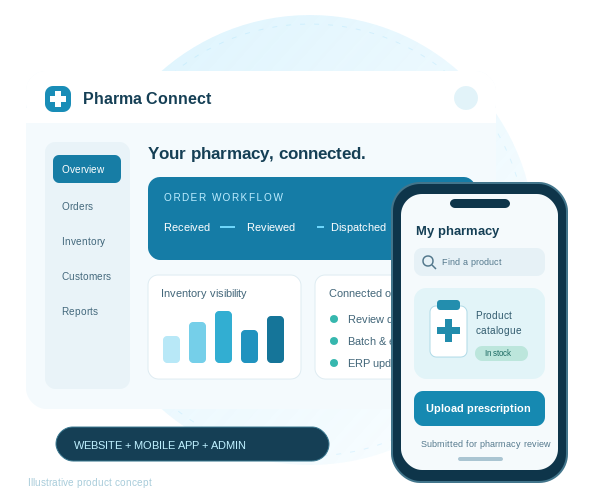
Illustrative pharma ordering dashboard and mobile app concept
Choose your first release

Choose a pharma website, pharmacy app or B2B platform

A manufacturer’s website, a pharmacy’s ordering service and a distributor’s trade portal solve different problems. Compare the journeys below, then use the starting offers to plan your budget.

Corporate pharma website

For manufacturers, brands and franchise businesses that need product enquiries.

The buyer journey
Find a product → read its details or brochure → send an enquiry.
What your team can do
We build pharma product catalogue websites with company information, product categories, brochures and franchise enquiry forms. Your team decides who writes, approves and publishes each update.
Decisions before the quote

Set page and product counts, languages and brochure versions. Decide which markets can view each product and who receives enquiries. We quote separately for ecommerce, customer accounts and ERP connections.

Pharmacy website & mobile apps

For pharmacies that want customer ordering on the web, Android and iOS.

The buyer journey
Find a product → upload documents if required → pharmacy review → order confirmation → delivery updates.
What your team can do
We build pharma ecommerce websites and medicine delivery apps that connect product search, order requests, prescription uploads and payment status. Your pharmacy team defines the review steps.
Decisions before the quote

Choose the customer and staff screens, branches, stock source and delivery zones. Agree cancellations and returns. Add rider apps or electronic-prescribing integrations only when your proposal includes them.

B2B distributor platform

For distributors and stockists that need business-to-business (B2B) ordering.

The buyer journey
Approve the trade account → show its prices → review the order → allocate stock → confirm dispatch.
What your team can do
We build pharmaceutical B2B ecommerce platforms that bring wholesale requests, account prices and order status together. Define pack sizes, minimum quantities, discounts and credit checks.
Decisions before the quote

Set product, warehouse and staff-role limits. Review batch and expiry records, returns and ERP access. We quote separately for field-sales apps, CRM and supply-chain modules.

Do you need a new platform or a better connection?

  • Start with a website when buyers need product details, brochures and enquiry forms.
  • Connect existing tools when staff copy orders or stock between systems that otherwise work well.
  • Build custom software when standard tools cannot support your review rules, trade pricing or customer journey.

Choose the functions your first release needs. Each starting offer includes the listed platforms, an admin panel and maintenance. Your written quote confirms features and quantities.

Compare your starting options

Pharma website and app development costs

Every offer includes custom development, an admin panel and six months of maintenance. Prices below start in USD. Your proposal confirms the features, quantities and final amount.

OPTION 01

Corporate pharma website

For manufacturers, brands and franchise businesses.

From USD 799

2 weeks estimated delivery

Included platforms
Website
Administration
Admin panel included
Development approach
Custom development
What the quote must cover
Includes a website and admin panel. Your quote sets the pages, products, languages and content-entry work. We quote separately for ordering, payments, mobile apps and ERP connections.
Plan the acceptance check

Example acceptance check: An administrator publishes a product and brochure. The website sends an enquiry to the right team and works on mobile.

Discuss the corporate website
OPTION 02

Pharmacy website & mobile apps

For customer ordering and pharmacy operations.

From USD 1,499

3–4 weeks estimated delivery

Included platforms
Website + Android + iOS
Administration
Admin panel included
Development approach
Custom development
What the quote must cover
Your quote sets customer and staff screens, product and branch counts, ordering and review functions. It must list any rider app, electronic-prescribing connection, integration or migration work.
Plan the acceptance check

Example acceptance check: A test order follows the pharmacy review rule, records the payment result and shows the same fulfilment status to customers and staff.

Discuss the pharmacy platform
OPTION 03

B2B distributor platform

For distributors and stockists managing trade orders.

From USD 2,499

5+ weeks estimated delivery

Included platforms
Website + Android + iOS
Administration
Admin panel included
Development approach
Custom development
What the quote must cover
Your quote sets trade-buyer roles, product and warehouse counts, pricing rules and reports. It must list any ERP connection, migration work, field-sales app or manufacturing function.
Plan the acceptance check

Example acceptance check: A trade buyer sees the correct price. Staff can review a stock or credit exception, and the system prevents duplicate orders during reconciliation.

Discuss the B2B platform

Your quote sets page, product, branch and warehouse counts; starting prices do not include unlimited quantities. It also lists your selected functions. Features elsewhere on this page only form part of the price when your proposal includes them.

Six months of maintenance

We fix bugs and provide security and operating system updates. We respond within one business day to acknowledge and assess your request. Resolution depends on the issue. Your proposal sets support hours, time zone and holidays. We quote separately for new features and extended maintenance.

Additional costs

Starting prices exclude GST, hosting and third-party API fees. Your proposal lists integration and data migration costs. An API provider’s usage charges are separate from the work we do to connect its service.

Delivery & handover

You own the source code after we migrate the work. Estimates start once you approve the scope and provide content and access. Your proposal records migration sign-off, milestones, maintenance dates, third-party licences and ownership of hosting and app-store accounts.

What affects the price and delivery time?
  • Product size: screens, user roles, catalogue size, branches, languages and approval steps.
  • Existing systems: integration work, vendor access, API fees and the records we need to migrate.
  • Launch work: design approvals, testing, training and app-store reviews.
  • Handover and support: migration, source code, licences, account ownership and the support calendar.

New scope, delayed feedback, unavailable ERP APIs and app-store review can change the launch date.

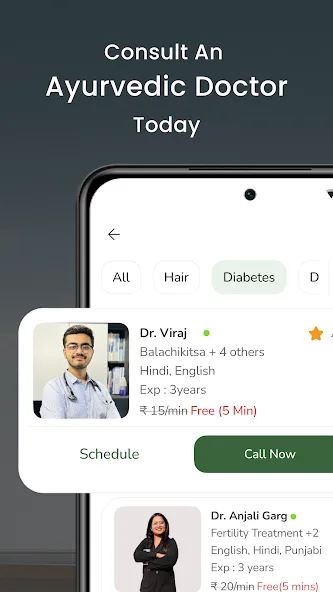
Amrutam welcome screen from its public Google Play listing Amrutam public app screen showing Ayurvedic practitioner discovery
Public app screenshots from Amrutam’s Google Play listing. The case study separates public product features from Digittrix’s confirmed delivery.
Related healthcare & wellness experience

Amrutam: apps for customers and doctors

Digittrix built Android and iOS apps for Amrutam’s customers and doctors, plus administration and reporting tools.

  • Customer and doctor apps for Android and iOS.
  • Calling and prescription features within the mobile delivery.
  • An admin panel and reports alongside the apps.
Read the Amrutam case study

What this project shows: customer and doctor apps with calling, prescriptions, administration and reports. It does not demonstrate distributor ERP, warehouse traceability or manufacturing software. We assess those requirements separately.

Baseline booking counts and comparison dates are unavailable, so we do not publish a booking-growth percentage.

Delivery scope confirmed by Digittrix on . See the case study for project details and public product sources.

Connected roles

Plan the tools each user needs

Choose what customers, pharmacy staff and administrators need to do. Your proposal confirms which functions your first release includes.

A clear path from discovery to delivery

Help customers browse your catalogue, share the required documents and follow approved orders.

  • Account and address management
  • Product search and availability
  • Prescription upload where required
  • Pharmacy review and clarification
  • Cart, payment and order history
  • Delivery updates and support
  • Refill requests and reminders
  • Privacy and notification preferences
Illustrative connected pharmacy ordering platform

Keep every order connected to operations

Give your team the information and review steps it needs to process orders consistently.

  • Prescription review queues
  • Approve, hold or decline with reasons
  • Batch, expiry and stock records
  • Supplier and purchase order management
  • Trade pricing and bulk order requests
  • Branch allocation and dispatch
  • Returns and reconciliation
  • Customer communication history
Illustrative connected pharmacy ordering platform

One view of your pharma platform

Manage access, content and operations through permissions tailored to each team.

  • Role-based access and staff accounts
  • Product categories and content approval
  • Branch and delivery-area configuration
  • Order and payment oversight
  • ERP, CRM and integration status
  • Audit history for key actions
  • Enquiries and franchise lead pipelines
  • Business reports and export controls
Illustrative connected pharmacy ordering platform
Controls by design

Protect documents, orders and stock records

Build clear permissions and review steps into the product from the start.

Protected document access

Limit prescription and customer document access to authorised roles, with agreed storage and retention controls.

Human review workflows

Use review queues, clarification requests and approval records for orders that need pharmacy oversight.

Inventory accountability

Record batch, expiry and stock movement data, with alerts and checks defined around your operations.

Reliable platform operations

Plan encrypted connections, backups, monitoring, audit history and recovery procedures around the deployment.

Your qualified pharmacy team and advisers define product eligibility, prescription handling and launch requirements for each market.

Explore a working technical example

One Order, One Stock Reservation

What happens when an ERP accepts a distributor order but its response never reaches the portal? This runnable example shows how a retry can recover the result without reserving stock twice.

  1. Start with 10 available packs.A synthetic buyer orders 4 packs of one demonstration SKU from one warehouse. The portal sends a stable request key with the order.
  2. The ERP accepts the order; the portal misses its response.Stock falls to 6 packs. The portal shows the order as awaiting confirmation instead of assuming it failed.
  3. Retry the same request and recover the original result.The ERP recognises the buyer, key and unchanged payload. The outcome is still one order and 6 available packs.

Try the failure scenarios

Each button starts a fresh example with the same 10 packs. It runs in your browser using synthetic data.

Expected: 1 order · 6 packs available

Retrying an accepted request must not create a second order. Choose a scenario to run the check.

Field mapping and sample request

These are neutral example fields, not a connector for a named ERP. Confirm the actual API fields, ownership and pack units with your provider.

Buyer account → buyerId
Associate the authenticated buyer with the correct ERP account; scope request keys to that buyer.
Portal order → orderId
Keep one business order identity. A new request key must not recreate an already accepted order.
Retry token → requestKey
Reuse the token for the same payload after a timeout. A changed quantity using that token is a conflict.
Product and location → sku, warehouseId
Map the catalogue product to the ERP SKU and warehouse before reserving stock.
Ordered packs → quantityPacks
Use positive whole packs in this model. Agree unit and pack-size conversions in a real integration.
Stock snapshot → availablePacks, version
Accept only newer versions for the same SKU and warehouse. The example moves from version 17 to 18.
{
  "buyerId": "DEMO-BUYER-A",
  "orderId": "DEMO-1001",
  "requestKey": "DEMO-BUYER-A:DEMO-1001:v1",
  "sku": "DEMO-SKU-001",
  "warehouseId": "WH-DEMO",
  "quantityPacks": 4
}
What was tested, and what a production integration still needs

9 automated checks passed on 13 October 2026: repeat retries, changed payloads, buyer isolation, duplicate business orders, insufficient stock, invalid quantities, unmapped stock, snapshot validation and the three interactive outcomes. Download the code and rerun them with node verify.mjs.

This is a sequential, in-memory teaching model. It does not test a live ERP, concurrent requests or recovery after a server restart. It contains no client, patient or medicine records and is not evidence of a delivered client system.

  • Persist the decision atomically: use durable unique request and order records with the stock change in one transaction. Test simultaneous requests and a crash after commit.
  • Reconcile uncertain results: query by stable order identity, use bounded retries and route unresolved failures to staff. A timeout alone does not prove the order failed.
  • Deliver stock events reliably: agree version scope and event ordering; use durable publishing and reconciliation so a committed change is not lost between systems.
  • Agree the business controls: buyer access, pack conversion, batch and expiry eligibility, credit checks, amendments and returns need their own rules and acceptance tests.

Technical background: AWS on safe retries and request identity; AWS on the transactional outbox pattern.

Connect the systems behind every order

Connect your ERP, payments and delivery systems

Connect your enterprise resource planning (ERP), customer relationship management (CRM), payments and delivery tools. We check each vendor’s API and software version before promising compatibility. Your proposal lists every integration and migration task.

ERP & inventoryCatalogue, stock and order synchronisation
What moves between systems
Your stock system sends product IDs, batch numbers, expiry dates, available quantities and prices. The platform sends approved orders and receives stock-allocation or rejection updates.
Who provides access
Your ERP owner or vendor supplies API documentation, a test account, sample records and permission to read or update the agreed fields.
Acceptance check
The platform flags stale stock. Retrying a timed-out request must not create a second order or stock movement. Staff can review unresolved records.
Payments & refundsVerified payment outcomes tied to orders
What moves between systems
The payment provider reports transaction and refund status. Your platform links each outcome to the correct order; a browser success screen alone does not confirm payment.
Who provides access
Your payment-account owner provides sandbox access, enabled currencies and the provider’s supported notification and refund methods.
Acceptance check
Verify notification authenticity, handle duplicate or out-of-order updates, and test failed payments, partial refunds and delayed confirmations.
CRM & field salesEnquiries, trade accounts and follow-ups
What moves between systems
Send approved enquiries and account activity to the CRM. Agree whether the CRM or platform owns customer details, territory assignments and sales stages.
Who provides access
Your sales or CRM owner approves field mappings, required fields, user permissions and the rules for merging duplicate accounts.
Acceptance check
An enquiry reaches the correct owner once. Restricted customer data stays within approved roles, and failed updates remain visible for follow-up.
Shipping & deliveryDispatch requests and tracking updates
What moves between systems
Send approved shipment details to the delivery provider and return tracking events to the order. Agree service areas, cancellation rules and permitted data sharing.
Who provides access
Your logistics owner supplies provider access, service codes, pickup locations and supported delivery requirements for the launch market.
Acceptance check
Test unavailable service areas, failed booking, cancellation and repeated tracking events. A failed request must not silently create a second shipment.
Accounting & trade billingInvoices, credit notes and reconciliation
What moves between systems
Link orders to invoice numbers, payment allocations and approved credit notes. Your finance team identifies the system that owns invoice and tax records.
Who provides access
Your finance owner supplies account mappings, numbering rules, currencies and tax settings approved for each launch market.
Acceptance check
Match invoice totals and rounding to the order. Repeated updates must not create duplicate invoices. Send rejected entries to a staff review queue.
Email, SMS & WhatsAppOrder messages with delivery status
What moves between systems
Send approved order or support notifications through the selected provider. Record delivery outcomes and apply the agreed consent and opt-out rules.
Who provides access
Your messaging-account owner supplies verified sender access, approved templates where required, and the recipient and content rules.
Acceptance check
Test rejected templates, unreachable recipients and provider limits. Avoid repeated messages and keep prescription or sensitive details out of routine notifications.

Agree the connection before development

Start with evidence: share vendor documentation, anonymised sample records and a vendor contact. Agree field mappings, identifiers, permissions, data volumes and update frequency. An available API does not always provide batch, expiry or branch-level stock.

Plan for interruptions: protect access keys, validate incoming updates and prevent duplicate writes. Retry temporary failures with increasing delays and a defined limit; send unresolved records to a visible review queue. Agree monitoring and reconciliation responsibilities.

Define the handover: record test results, data mappings, recovery steps, alert owners and launch/rollback approvals in the agreed delivery scope. Your proposal confirms source-code handover, account ownership and vendor dependencies. Starting prices exclude third-party API fees.

Technology blueprint

Technology for your website, apps and backend

We choose technologies that fit your ordering process, existing software, data needs and expected demand. Your team’s ability to maintain the platform also shapes the choice.

Architecture layers

We confirm the technology choices during discovery, after reviewing features, access controls, integrations and long-term ownership.

01 · Customer experience

Frontend & Mobile

We use Next.js for web interfaces and choose Flutter, Swift or Kotlin for mobile apps, based on the project’s platform needs.

4 technologies
Next.js logo

Next.js

Flutter logo

Flutter

Swift logo

Swift

Kotlin logo

Kotlin

02 · Orders & integrations

Backend APIs

We select backend tools from Node.js, PHP, Laravel, Python and CodeIgniter to handle orders, stock updates, pharmacy reviews and integrations.

5 technologies
Node.js logo

Node.js

PHP logo

PHP

Laravel logo

Laravel

Python logo

Python

CodeIgniter logo

CodeIgniter

03 · Catalogue, stock & records

Data Layer

We choose databases around your catalogue, orders and branch stock. We also plan how staff record batches and expiry dates, run reports and retain or delete records.

5 technologies
MySQL logo

MySQL

MongoDB logo

MongoDB

PostgreSQL logo

PostgreSQL

Firebase logo

Firebase

MariaDB logo

MariaDB

04 · Scale & release

Cloud Delivery

We assess Azure, Google Cloud and Docker for hosting and deployment, and Vercel or Netlify for suitable web projects. We plan test environments, monitoring and releases around your requirements.

5 technologies
Microsoft Azure logo

Microsoft Azure

Docker logo

Docker

Google Cloud logo

Google Cloud

Vercel logo

Vercel

Netlify logo

Netlify

05 · Payments & trade billing

Payments & Billing

We assess Stripe, Razorpay, PayPal or Cashfree for payments and refunds, subject to provider approval for your business and market. Your proposal defines any trade-billing connection.

4 technologies
Stripe payment logo

Stripe

Razorpay logo

Razorpay

PayPal logo

PayPal

Cashfree logo

Cashfree

06 · Identity & access

Authentication

We combine token-based access with the sign-in methods your users need. We also define session limits, device controls and staff permissions.

1 core technology

JWT

A clear delivery process

How we build and launch your pharma platform

Our pharmaceutical software development services cover planning, design, development, testing and launch. We agree markets, languages, currencies, meeting times and project approvers at the start.

01

Discover

We map your customers, staff roles, markets and first-release priorities.

02

Design

We design the catalogue, ordering and review screens so your team can test the journey.

03

Develop

We build the website, apps and agreed integrations in stages you can review.

04

Validate

We test permissions, stock changes, prescription access, failed payments and order exceptions.

05

Launch

We prepare content, hosting, app-store submissions, training and the rollout plan.

06

Improve

We use support requests and operational feedback to plan the next release.

People & responsibilities

Who oversees your pharma project?

Vandana Abrol

Vandana Abrol

Co-Founder of Digittrix

Technical owner · Pharma development

Vandana coordinates your project requirements, integration decisions and delivery escalations with the engineering team.

Read Vandana’s bio
Engineering & QA
Your proposal names the engineering and quality assurance (QA) leads. They oversee architecture, API data mapping, acceptance tests and release checks. Your pharmacy specialists and advisers handle clinical and regulatory review.
Your business & system owners
Your team approves operating rules and acceptance scenarios. Your IT team or vendors provide authorised access and confirm which system owns each record.
Your qualified pharmacy team
Pharmacy professionals and your advisers define prescription review, product eligibility and market requirements. Technical ownership covers software delivery.

Page updated · Contact Digittrix about this service

Experience you can explore

Explore Our Work & Development Services

Explore our published projects, client feedback and related services while planning your pharma platform.

Our portfolio and client reviews reflect Digittrix’s delivery experience across industries.

Explore regional delivery options: pharma app and website development in Mohali or pharma app development for Delhi-NCR, with delivery details and INR starting budgets.

2 client video reviews

Client Reviews of Web & Mobile Delivery

Hear from clients who hired Digittrix for a mobile app and a custom website. These reviews describe our wider delivery work, not pharmaceutical projects. Each review links to its source video and transcript.

Direct buyer answers

Pharma development: questions before you start

Clear answers on cost, scope, platforms, integrations, security, ownership, and launch support.

What does a pharmaceutical app development company build?

We build corporate websites, pharmacy ordering apps, distributor portals and business software for pharma companies. Customers browse products and place requests; staff review orders and manage stock. We connect the website, mobile apps and admin panel to a shared backend where your project needs them.

How do I choose a pharma website development company?

Ask the company to demonstrate catalogue editing, product search and enquiry handling. Check its relevant projects, integration approach and support terms. Compare the proposed features, quantities and acceptance tests alongside the price. A pharmaceutical website development company should explain what your first release includes and what costs extra.

Can the platform support prescriptions and pharmacist review?

Yes. We can add document uploads, restricted access, review queues and requests for clarification. Your qualified pharmacy team sets the review rules and decides when to accept an order. Uploading a prescription does not replace pharmacist review or create an electronic-prescribing connection.

Can you connect our existing ERP or inventory software?

We check your software version, API documentation, sample data and test access first. Then we agree which system controls stock, prices and invoices, how often it updates them and who resolves failed updates. Your proposal lists each integration, migration task and implementation cost. Third-party API fees cost extra.

How much does a pharma website or app cost?

Custom development starts at USD 799 for a corporate website, USD 1,499 for a pharmacy website with Android and iOS apps, and USD 2,499 for a B2B distributor platform with the same platforms. Each offer includes an admin panel and six months of maintenance. Your proposal confirms features and quantities. GST, hosting and third-party API fees cost extra.

How long does development take?

We estimate two weeks for a corporate website, three to four weeks for pharmacy web and mobile apps, and five weeks or more for a B2B platform. Work starts after you approve the scope and provide the required content and access. Extra features, delayed approvals, unavailable integrations and app-store reviews can change the launch date.

Can we manage multiple pharmacies or branches?

Yes. We can add branch stock, prices, staff permissions, delivery zones and order routing. Before development, we agree how branches share inventory, transfer stock and handle unavailable items. The quote sets the number of branches and the functions each branch needs.

How do you approach privacy and security?

We plan access permissions, encrypted connections, protected documents, audit records, backups and retention rules. Your qualified team and advisers review the legal and regulatory requirements for each launch market. Software controls support that work; they do not establish compliance on their own.

Can you build a PCD pharma or franchise website?

Yes. We can organise product categories, brochures, territory enquiries and sales follow-ups in a PCD pharma website. Your team approves product information and claims before publication. We price trade logins, ecommerce checkout and dealer portals separately when you need them.

What happens after launch?

We provide six months of bug fixes and security and operating system updates. We acknowledge and assess support requests within one business day; resolution depends on the issue. You own the source code after we migrate the work. Your proposal confirms support hours, account ownership and handover. We quote separately for new features and extended maintenance.

Can you build a pharma distributor app for trade buyers?

Yes. A pharma distributor app can show approved buyers their catalogue, account prices, order history and delivery status. We define stock allocation, credit checks and invoice updates with your team. Your existing systems and their available APIs determine which connections we can build.

Can you build pharmaceutical manufacturing or laboratory software?

Manufacturing, laboratory and quality systems need a separate assessment. Your specialists must define batch records, approvals, traceability and validation needs. This page covers websites, ordering and connected business software. We review the requirements before proposing pharmaceutical ERP software development or manufacturing functions.

Can we introduce new software in stages?

Yes. Start with the task that matters most, such as catalogue enquiries, distributor orders or stock visibility. Then add CRM, field sales, ERP connections or mobile apps when your team is ready. Our pharmaceutical digital transformation services include planning how each release shares data and fits your existing systems.

Do you work with pharma businesses worldwide?

Yes. We serve pharmaceutical companies, pharmacies and distributors worldwide. We plan your launch markets, languages, currencies, meeting times and approval process together. Your team and advisers define local operating requirements. Online discovery sessions let us review your catalogue, ordering steps and current software before we quote.

Who oversees technical delivery?

Vandana Abrol, Co-Founder of Digittrix, coordinates planning, integration dependencies and delivery escalations with the engineering team. Your proposal names the engineering and quality assurance (QA) leads and your own project approver. Your pharmacy team retains responsibility for prescription review and product eligibility.

What if our existing software has no usable API?

We check whether your vendor supports file exports, imports or another approved connection. A scheduled file transfer may work better than replacing a useful system. We agree validation and reconciliation checks before development. We only promise real-time updates when the source software supports them.

Should we build custom software or keep our existing tools?

Keep an existing system when it already handles your work reliably. Consider an integration when staff repeatedly copy orders or stock between tools. Choose custom development when standard software cannot support your approval rules, trade pricing or customer experience. If you only need product information and enquiries, start with a catalogue website.

Ready for a practical roadmap?

Start Your Pharma Website or App Project

Share your catalogue, ordering process, current software and launch market. We will help you choose a first release and prepare a project proposal.

Serving pharma businesses worldwide: pharmaceutical companies, pharmacies, distributors and retail chains.

Digittrix product, design, engineering and QA team together in the office
Meet the team behind your build Product, design, engineering and QA working together.