 +91-8727000867
 +64 22 003 5555


Highlights
- Build an astrology app with chat, voice calls, and horoscope features for user consultations.
- Plan development costs, astrology API integrations, and payment systems before the app launch.
- Set clear development milestones for app testing, astrologer onboarding, and platform launch.

Co-Founder
Harsh Abrol 
Since 2014, Digittrix has helped companies optimise digital products for stronger conversions.
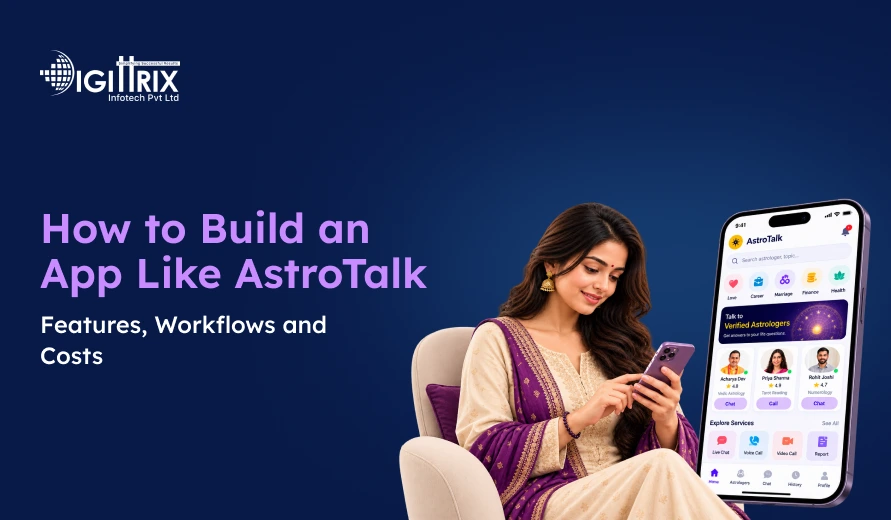
Building an astrology consultation platform requires more than a horoscope screen and a payment button. Customers need to find astrologers, check availability, book sessions, make payments, and access their consultation history. Astrologers need tools to manage their schedules and sessions, while administrators need control over bookings, disputes, payments, and platform content.
To build an app like AstroTalk, define the customer, astrologer, and admin workflows, choose your launch platforms, and plan booking, consultation, and payment rules. Start with a limited feature set, test billing and interrupted sessions, and add reports, subscriptions, or AI features when the business needs them.
This guide explains what to build first, how the main user roles work together, how to handle paid sessions and failures, and what to test before launch. It also outlines how project scope affects the development budget.
AstroTalk is referenced only as a functional example of an astrology consultation platform. This article is not affiliated with AstroTalk and does not recommend copying its branding, interface, content, or proprietary features.
Curious about AI in astrology? Explore Digittrix's insights on AI in Astrology to understand its benefits, applications, and future trends!
What Should You Build First?
AstroTalk app development cost guide: technologies or requesting quotes, decide which service your business will offer. A platform that provides daily horoscopes has different requirements from a marketplace where customers pay astrologers for live consultations.
A focused first release should support one complete customer journey from account creation to service completion. Adding every possible feature at the beginning can increase the development scope before the business has tested customer demand.
MVP features versus later features
|
Build in the first release |
Consider for a later release |
|
Customer registration and profiles |
Multiple languages and regional customisation |
|
Astrologer profiles and availability |
Advanced astrologer ranking |
|
Booking and session status |
Group sessions and webinars |
|
One selected consultation channel |
Additional chat, voice, or video options |
|
Payment confirmation and session billing |
Multiple subscription plans |
|
Essential admin controls |
Advanced business analytics |
|
Notifications and support requests |
AI-assisted recommendations |
|
Basic horoscope or kundli service, if required |
Premium reports and expanded astrology tools |
The final selection depends on the business model. For example, a content-led horoscope product may not need a live astrologer marketplace at launch. A consultation-first product, however, needs booking, availability, session tracking, and payment handling from the beginning.
 Build an Astrology Consultation App Like AstroTalk
Planning an astrology app? Talk to Digittrix experts about app features, astrologer bookings, payment integration, and development costs.
The Three User Roles and How They Work Together
A consultation platform usually has three main user groups. Their workflows must connect correctly, because a problem in one area can affect the entire customer experience.
1. Customer workflow
The customer-facing product should make the next action clear at every stage.
A typical journey looks like this:
- Register or sign in.
- Enter relevant profile details.
- Browse astrologer profiles, services, prices, and availability.
- Select a consultation method and book a session.
- Complete the required payment.
- Join the session or wait for the scheduled appointment.
- Receive a completion status and transaction record.
- Contact support if the session or payment did not go as expected.
The customer experience should also explain cancellation terms, waiting periods, refund conditions, and whether a consultation is charged by time or at a fixed price.
For a horoscope app, the journey may instead focus on birth details, daily or weekly readings, saved reports, and optional paid services. Collect only the personal information the selected features require.
2. Astrologer workflow
Astrologers need a separate workspace, which may be a mobile app, a web dashboard, or both, depending on the approved scope.
Core tasks include:
- Creating and updating a profile.
- Setting working hours and availability.
- Accepting, declining, or rescheduling bookings.
- Starting and ending consultations.
- Viewing completed sessions and relevant payment records.
- Reviewing platform rules and support messages.
Availability must be linked to booking status. If an astrologer is already in a paid session, the system should not allow another customer to book the same slot unless the business has deliberately designed a queue or overlapping-session model.
The platform should also define how astrologers are verified, what profile claims they may make, and how customer complaints are reviewed. These are operating rules as well as software requirements.
3. Admin workflow
Administrators oversee the marketplace and handle exceptions that automated workflows cannot resolve.
The admin dashboard should provide access to:
- Customer and astrologer accounts.
- Profile review and account restrictions.
- Booking status and session history.
- Payment records, refunds, and disputes.
- Pricing, commissions, and promotional settings.
- Customer complaints and support requests.
- Basic usage, revenue, and failure reports.
Access should be role-based. For example, a support employee may need to review a disputed session but should not automatically have permission to change platform-wide payment settings.
 7-Day Risk Free Start
Start Your 7-Day Free Trial With Proven Experts
If this article sparked a project idea, start with a dedicated expert for 7 days at no risk. Continue at just $10/Hour if the collaboration is the right fit for your business.

Dedicated Expert Access
Work directly with a specialist aligned to your project goals and timeline.

Direct Chat with Your Team
Collaborate in real-time and get instant support.

Screenshots & Reports
Receive regular reports to track progress transparently.

No Contracts
No commitments. Cancel anytime, no hassle.

Limited Slots Available This Week!
Kickstart Your Project With Zero Risk And Total Confidence.


& Growing Brands
Essential Features
The feature list should follow the selected service model rather than attempting to match every feature found in existing astrology platforms.
Booking and session management
Booking records should include the customer, astrologer, scheduled time, selected service, price, payment status, and current session state. The system should distinguish between a booking request, a confirmed appointment, an active consultation, a completed session, and a cancelled session.
This prevents confusion when a customer pays but cannot connect, or when an astrologer is unavailable at the scheduled time.
Chat, voice, or video consultations
Choose the communication channel according to the audience and operating model. Text chat may be sufficient for a first release, while voice and video can require additional provider integration, permissions, connection handling, and testing.
If the consultation uses a third-party communication service, confirm its pricing, supported platforms, recording policy, data handling, and technical limitations before finalising the architecture.
Horoscope and birth-chart services
A product that offers horoscope or kundli calculations needs a defined calculation method and a suitable data source or calculation provider. Requirements may include date and time of birth, birthplace, time zone handling, chart generation, and saved reports.
Chart-calculation accuracy and the validity of astrological predictions are different questions. Software testing can check whether the system applies the selected calculation method correctly to the supplied inputs. It cannot establish that a prediction about a person's future is scientifically valid.
Payments and account records
Payment features should support the business's pricing rules and maintain a clear record of transactions. Depending on the model, this may include session charges, prepaid balances, commissions, subscriptions, or paid reports.
Do not treat a payment gateway connection as the entire billing system. The application also needs to record what was purchased, whether payment was confirmed, what service was delivered, and whether a refund or adjustment is pending.
Notifications and support
Send appropriate notifications for booking confirmation, appointment reminders, session changes, payment status, and support updates. Avoid sending repeated notifications when a booking or payment status changes several times during error recovery.
Step-by-Step Development Process
A complete build process covers planning, design, implementation, testing, release, and post-launch monitoring.
Step 1: Define the business model and launch scope
Decide whether the product will offer live consultations, horoscope content, paid reports, subscriptions, or a combination of services. Specify the first customer journey and the features that can wait.
Document what the first release must do, what is excluded, and how success will be measured. This becomes the basis for design, estimates, and testing.
Step 2: Confirm Android, iOS, and customer website requirements
List the required delivery platforms separately:
- Android app: A customer app and, if required, a separate astrologer app or workspace.
- iOS app: A customer app and any additional role-specific experience included in the agreed scope.
- Customer website: A responsive website for browsing services, managing accounts, booking, and accessing supported features.
- Admin dashboard: A controlled web interface for managing users, bookings, transactions, and support.
Not every project needs all four surfaces at launch. A focused MVP may begin with one customer app or a responsive customer website and essential admin controls. If Android, iOS, a customer website, and an astrologer workspace are all required, each should be listed in the estimate.
Step 3: Design and approve the screens
Prepare the key screens for registration, service discovery, astrologer profiles, booking, payment, consultation, account history, and support. Design the astrologer and admin workflows separately.
Review navigation, error messages, accessibility, and mobile layouts before development starts. Approved designs reduce ambiguity when the team begins implementation.
Step 4: Select calculation, payment, and communication providers
Choose the providers required by the product. This may include a horoscope or kundli calculation service, a payment gateway, a chat or video provider, push notifications, analytics, and customer-support tools.
Check provider documentation, charges, regional availability, data retention, rate limits, and platform compatibility. Do not assume that a provider offers every feature or that API access is included in the development quote.
Step 5: Build the apps, website, and backend
Develop the customer-facing product, astrologer workspace where required, admin dashboard, and backend services. The backend should manage accounts, availability, bookings, session status, pricing, payments, notifications, and access permissions.
Keep business rules consistent across platforms. For example, if a booking is cancelled on the website, the same status should be reflected in the mobile app and admin dashboard.
Step 6: Test bookings, billing, refunds, and calculations
Test normal journeys and failure cases before release. Include cases where a payment succeeds but the app does not receive the confirmation immediately, a customer disconnects during a consultation, an astrologer misses a session, or a refund remains pending.
For calculation features, test expected outputs against the chosen provider's documented behaviour and approved test cases. Do not use a few successful screens as proof that every birth-chart calculation or time-zone case works correctly.
Step 7: Prepare store submissions and launch
Prepare the app descriptions, screenshots, privacy disclosures, support details, permissions, and other required submission materials. Review current Apple and Google Play requirements for the product's features, payment model, user data, and content.
App-store approval is not automatic. Apple specifically warns against copycat apps and expects products to provide adequate functionality and lasting value. An original product should have its own service proposition, user experience, content, and branding. Read Apple’s App Review Guidelines.
Step 8: Monitor the product after launch
After release, review booking completion, payment failures, session interruptions, refund requests, customer support volume, crashes, and operating costs.
Use this information to decide which issues need immediate attention and which new features should be added later. A launch is the start of ongoing product management, not the end of development.
How to Handle Paid Sessions and Failed Transactions
Payment and consultation failures deserve their own design and test plan. A successful gateway response does not necessarily mean that the customer received the service.
Define clear session and payment states before development. For example:
|
Situation |
Expected system response |
|
Payment succeeds and booking is confirmed |
Show confirmation and reserve the appointment |
|
Payment is pending |
Avoid creating a duplicate charge; check the final transaction status |
|
Payment fails |
Explain the failure and provide a safe retry path |
|
Customer pays but cannot join |
Record the incident and follow the stated recovery or refund policy |
|
Astrologer does not attend |
Apply the defined cancellation, rescheduling, or refund process |
|
Consultation ends unexpectedly |
Record the session state and apply the agreed billing rule |
|
Refund is requested |
Track the request, decision, and gateway status until resolved |
For time-based billing, define when charging begins and ends, how connection interruptions are handled, and how disputed session duration is reviewed. For fixed-price bookings, define what qualifies as service completion.
Use transaction identifiers and idempotent processing where supported, so repeated requests do not accidentally create duplicate charges or refunds. Keep an auditable record of state changes, with access limited to authorised staff.
How Much Does It Cost to Build an App Like AstroTalk?
For a consultation marketplace with customer, astrologer and admin workflows, Digittrix’s published starting planning range is USD 2,500–4,000, with a typical timeline of 6–8 weeks under an agreed scope using established components. The lower-priced focused customer MVP is a different product scope.
Digittrix’s published planning ranges also include:
- Focused customer-app MVP: USD 1,500–2,500, with a typical timeline of 4–6 weeks.
- Consultation marketplace MVP: USD 2,500–4,000, with a typical timeline of 6–8 weeks.
- Custom multi-platform product: USD 4,000–10,000+, with a typical timeline of 8+ weeks.
These are indicative planning estimates, not guaranteed prices or delivery dates. The final quote depends on the required platforms, features, third-party integrations, design, testing, and launch support. Confirm whether Android, iOS, the customer website, the astrologer workspace, and the admin dashboard are included before comparing proposals.
See the Digittrix astrology app development service for the published scope and planning estimates.
What each estimate covers
Focused customer-app MVP: The published scope includes one customer app or responsive web experience, authentication, one selected horoscope or kundli service, payments, notifications, and essential admin controls. A dedicated astrologer workspace is not assumed.
Consultation marketplace MVP: The published scope includes customer, astrologer, and admin workflows, with booking, chat or video, wallet, subscriptions, reports, moderation, and selected integrations. The final scope must specify the supported communication channels and the billing rules.
Custom multi-platform product: This tier may include iOS, Android, and web options, marketplace operations, payouts, custom calculation requirements, AI-assisted features, data migration, or more complex integrations. The exact platform combination and feature list must be confirmed during discovery.
The listed timelines assume an approved backlog, ready content and API credentials, established components, and timely design feedback. Infrastructure, third-party charges, ongoing operations, and other services are separate unless the written proposal explicitly includes them.
For a project-specific estimate, compare the detailed AstroTalk app development cost guide with the scope you actually need. Avoid comparing prices without checking what each estimate includes.
Payment Rules Depend on What You Sell
Payment planning is not just a gateway decision. The rules may differ depending on whether a customer purchases a live consultation, a digital report, a subscription, or an AI-based feature.
Apple's guidelines allow alternative payment methods for certain real-time, one-to-one person-to-person services. They distinguish these from one-to-few and one-to-many real-time services, which are subject to different in-app purchase requirements. Digital features and subscriptions may also be treated differently depending on the product and applicable rules.
Review Apple’s payment guidelines and Google Play’s billing policy before deciding how payments will work on each platform. Requirements can vary by product type, storefront, and programme. Confirm the rules that apply to the specific release rather than assuming one payment method is permitted everywhere.
Privacy, Trust, and Responsible Content
Astrology products may collect birth details, contact information, conversation records, payment-related information, and other personal data. Collect only what the product needs, explain how it is used, set appropriate retention periods, and restrict staff access.
Use secure authentication, access controls, protected data transfer, and appropriate monitoring. Review third-party provider terms and privacy requirements before transferring personal information to an external service.
If the product uses AI-generated readings or recommendations, tell users when AI is involved, explain the limits of the feature, and provide a way to report errors or inappropriate content. Do not present automated interpretations as verified facts.
Astrology content should also state that it does not replace qualified medical, legal, or financial advice. Avoid making unsupported promises about health, money, relationships, or future events.
Build an Astrology Consultation App Like AstroTalk
Planning an astrology app? Talk to Digittrix experts about app features, astrologer bookings, payment integration, and development costs.
What to Measure After Launch
The first release should help the business understand whether customers can complete the intended journey and whether the platform can operate within its budget.
Track a small set of useful measures:
- Booking completion: How many customers who start a booking finish it?
- Payment success: How often do payments complete without manual intervention?
- Session completion: How many confirmed consultations finish as expected?
- Failure and refund rates: Which problems lead to support requests, cancellations, or refunds?
- Repeat use: Do customers return for another consultation or service?
- Operating costs: What are the costs of communication services, calculation APIs, infrastructure, payment processing, and support?
Interpret the measures together. For example, a high booking rate is not enough if sessions frequently fail or refunds take too long. Use customer feedback and support records to identify the next improvement.
Project Example: Your Pandit Ji Website and Android App
Digittrix’s project reference for Your Pandit Ji, now Devanchal, documents a website and Android app for spiritual services. The project is relevant to astrology consultation app development because it demonstrates how customers can access services and move through a booking journey.
One workflow to consider is the customer booking process: users browse the available services, choose an appropriate offering, provide the required details, and review the booking information. In a consultation marketplace, this journey should connect to astrologer availability, booking confirmation, payment status, and customer support.
The published project reference establishes website and Android scope. Do not infer an iOS release, delivery timeline, revenue results, or certifications from that evidence. For broader service details, see the Digittrix astrology app development service.
Launch Acceptance Checklist
Before publishing the apps or opening the platform to customers, verify each item that applies to the approved scope.
- Customers can register, sign in, and access their accounts.
- Astrologers can manage availability and booking status.
- Administrators can review bookings, accounts, and support issues.
- Customers see accurate prices and clear cancellation terms.
- Successful, failed, pending, and duplicate payment scenarios have been tested.
- Refund and disputed-session workflows have been tested.
- Interrupted consultations follow documented billing rules.
- Horoscope or kundli calculations have passed the agreed test cases.
- Privacy notices, permissions, and data access controls have been reviewed.
- App-store requirements and submission materials have been checked.
- Support contacts, monitoring, and incident-handling procedures are ready.
- Third-party and operating costs have been included in the launch budget.
Curious about how astrology apps process user data? Explore Digittrix's insights on Astrology App Data Processing to understand how apps manage user information and generate personalized astrological insights!
Plan Your First Release
A successful astrology platform starts with a defined service model and a complete, testable customer journey. Build the customer, astrologer, and admin workflows around the same booking and payment rules. Then confirm the platforms, integrations, privacy requirements, and launch checks before committing to a budget.
Start with the features needed to deliver the first service properly. Measure booking completion, payment issues, session failures, refunds, and operating costs after launch. Use that evidence to decide when to add more consultation channels, reports, subscriptions, or AI-assisted features.
 FAQ's