 +91-8727000867
 +64 22 003 5555


Highlights
- Digital certificates could raise buyer trust by 25% when key product details are shown.
- Live gold pricing could cut price questions by 35% through clear rate updates online.
- Secure checkout could increase completed orders by 20% with simpler payment step.

Co-Founder
Vandana Abrol 
An enthusiastic developer and skilled business management expert with over a decade of experience in the field
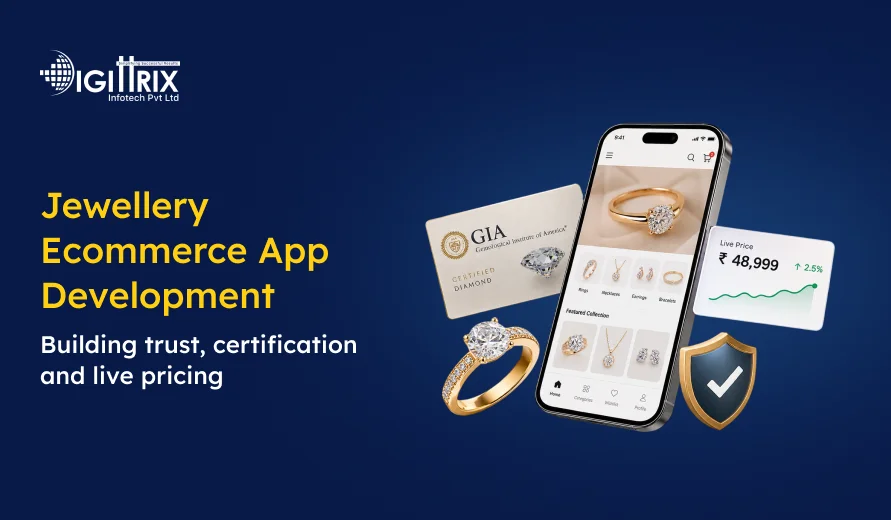
Nobody buys a gold chain or a diamond ring on a whim. Before paying, shoppers want to know the purity, weight, certification, making charges, and final price after tax. A jewellery brand that cannot answer these questions clearly on the product page can lose a sale, even when the product itself looks attractive.
That is why ecommerce app development for jewellery businesses requires more than a standard shopping interface. The app needs to present product details, certificates, current metal rates, secure payments, and order tracking in one place. It should also give customers enough information to make a high-value purchase with confidence.
This guide explains what a jewellery shopping app needs, how certification and live pricing can work, and what businesses should consider before starting development.
Want to understand the future of online retail? Check Digittrix's E-Commerce Technology & Trends insights to stay informed about emerging technologies!
Why ecommerce app development Matters for Jewellery Brands
Jewellery is a considered purchase. Shoppers compare designs, check weights, calculate prices, and often return to the same product several times before making a decision.
A mobile app supports this buying process by allowing customers to save favourites, compare pieces, check gold rates, receive order updates, and contact the business when needed. For brands with physical showrooms, the app can also connect online browsing with in-store visits.
A good jewellery product page can include:
- Photos from several angles
- Short product videos
- Metal type and purity
- Gross and net weight
- Diamond or gemstone details
- Certification and hallmark information
- Making charges and taxes
- Delivery timelines
- Return and exchange policy
- Available payment methods
When this information is available beside the product, customers do not have to contact support for basic questions.
For jewellery brands planning custom ecommerce app development, the catalogue should be designed around the way jewellery is priced, certified, sold, and delivered.
Building Trust Through Product Information
Online buyers cannot physically pick up a ring or necklace, so the product page needs to provide enough information to help them understand what they are buying.
Each listing should contain the product code, metal type, purity, gross weight, net weight, stone details, size, dimensions, and available variants. The price should also be broken down into understandable components.
For example, a jewellery product may show:
- Metal value
- Making charges
- Stone charges
- Other applicable charges
- Taxes
- Final payable amount
Showing these figures separately makes the calculation easier to understand. It also gives customers a clear explanation of why two visually similar pieces may have different prices.
High-resolution images from multiple angles can show design details, while videos can provide another view of the product. For rings, the app can also provide size information to help customers select the appropriate option.
 Build a Smart Jewellery Ecommerce App
Planning a jewellery ecommerce app? Talk to Digittrix experts about smart features, live pricing, certification, and secure shopping.
Jewellery Certification and Digital Verification
For diamonds, gemstones, and precious metals, certification can be an important part of the buying decision. Customers may want proof of purity, grading, or other product information before making a payment.
A jewellery app can display certification information directly on the product page, including:
- Certificate number
- Issuing laboratory
- Gold or silver purity
- Diamond cut
- Diamond colour
- Diamond clarity
- Carat weight
- Gemstone information
- Hallmark information
For gold jewellery sold in India, businesses can display relevant BIS hallmark information and the HUID (Hallmark Unique Identification) number where applicable.
A downloadable certificate can also be provided when appropriate. Another option is a QR code that takes the customer to the relevant verification page.
Certificate information should match the product record stored in the business system. Connecting certificate records with inventory data can reduce manual updates and lower the chance of mismatched product information.
Live Gold and Silver Pricing with ecommerce app development
Gold and silver rates can change during the day. If a jewellery application continues using an old rate, the displayed product price may not match the current calculation.
A jewellery application can connect with an approved pricing source or a rate system managed by the business. The application can then use the latest available rate while calculating product prices.
A common calculation may look like:
Current gold rate × net weight + making charges + stone charges + GST = estimated final price
The actual calculation depends on the business model, pricing rules, and applicable tax requirements. Businesses should confirm the formula with their accounts team and tax advisor.
Three points are particularly important for live pricing:
1. Show the Last Updated Time
Customers should be able to see when the displayed metal rate was last updated.
2. Explain the Price Type
The application should clearly state whether the displayed figure is an estimated amount or the final payable price. If a rate is locked for a certain period after checkout, that condition should also be explained.
3. Display Rates by Purity
Where applicable, the app can display different rates for 18K, 20K, 22K, and 24K gold.
A clear pricing system is especially important when businesses work with ecommerce mobile app development company teams that are integrating external rate feeds, inventory systems, and payment services.
 7-Day Risk Free Start
Start Your 7-Day Free Trial With Proven Experts
If this article sparked a project idea, start with a dedicated expert for 7 days at no risk. Continue at just $10/Hour if the collaboration is the right fit for your business.

Dedicated Expert Access
Work directly with a specialist aligned to your project goals and timeline.

Direct Chat with Your Team
Collaborate in real-time and get instant support.

Screenshots & Reports
Receive regular reports to track progress transparently.

No Contracts
No commitments. Cancel anytime, no hassle.

Limited Slots Available This Week!
Kickstart Your Project With Zero Risk And Total Confidence.


& Growing Brands
Key Features of a Jewellery Ecommerce App
Product Catalogue with Smart Filters
Products can be organised into rings, necklaces, earrings, bracelets, bangles, chains, bridal jewellery, diamond collections, and gemstone collections. Filters for price, metal, purity, stone, occasion, size, and collection help shoppers find relevant products faster.
Detailed Product Pages
Every product page should contain full specifications, images, price breakdowns, certification information, available sizes, and delivery details. Customers should have access to the information they need before adding an item to the cart.
Product Customisation
Some jewellery businesses allow customers to select ring sizes, metal types, gemstones, engraving options, or other variations. The application can recalculate the product price whenever a customer changes an option, allowing buyers to see how each selection affects the total.
Virtual Try-On
A virtual try-on feature can allow customers to preview how jewellery may look before making a purchase. Using the device camera or an uploaded photo, shoppers can virtually try rings, earrings, necklaces, bracelets, and other jewellery. This feature can also allow customers to compare different designs, sizes, metals, and styles before placing an order.
Secure Payments
The application can support cards, UPI, net banking, and approved digital wallets through an established payment gateway. Sensitive payment information should not be stored unnecessarily inside the application. Payment processing should follow the security requirements of the selected gateway and applicable regulations.
Order Tracking
Customers should be able to view payment confirmation, order status, production stages for made-to-order jewellery, dispatch details, and delivery updates. Push notifications can inform customers about important changes to their orders.
The Admin Panel Behind the App
The customer application is only one part of a jewellery ecommerce system. Business teams also need an admin panel to manage daily operations.
The admin panel can allow authorised staff to:
- Add and edit products
- Update metal rates
- Manage stock
- Upload certificates
- Update product images
- Process orders
- Manage customers
- Review payments
- Handle product variants
- Manage delivery information
Reporting tools can show sales trends, frequently viewed products, abandoned carts, repeat purchases, and order activity.
Role-based access can separate responsibilities. For example, a catalogue manager may update product information while an accounts employee handles payment records.
Businesses working with ecommerce app developers India can also connect the admin panel with existing ERP, CRM, inventory, and accounting systems.
Security and Privacy
Jewellery apps handle high-value transactions and personal customer information, so security should be considered from the beginning of the project.
Important areas include secure login, encrypted connections, protected payment processing, access controls, secure database management, and appropriate data retention practices.
The app should clearly present the privacy policy, return conditions, delivery terms, payment information, and other relevant policies before checkout.
For high-value purchases, businesses may also introduce an additional customer verification step before an order is confirmed or shipped.
Where AI Fits Into Jewellery Ecommerce
AI can be used when it solves a specific customer or business requirement.
A recommendation system can suggest jewellery based on browsing and purchase activity. A chat assistant can answer common questions about sizes, purity, delivery, product specifications, and certificates.
Visual search can allow customers to upload an image and find jewellery with a similar appearance from the available catalogue.
AI-based reporting can also help business teams identify frequently viewed products, popular categories, and changes in customer shopping behaviour.
These features should work alongside clear product information and human customer support.
Build a Smart Jewellery Ecommerce App
Planning a jewellery ecommerce app? Talk to Digittrix experts about smart features, live pricing, certification, and secure shopping.
Integrations Needed for Jewellery Ecommerce
A jewellery application may need several external systems. These can include payment gateways, gold and silver rate feeds, inventory software, ERP systems, CRM platforms, shipping services, analytics tools, certification databases, and notification services.
This is where ecommerce API integration becomes important. APIs allow the mobile application to exchange information with other business systems without requiring staff to enter the same information repeatedly.
For example, when an item is sold through a physical showroom, the inventory system can update its availability in the mobile application. Similarly, an updated metal rate can be passed to the pricing system and displayed on relevant products.
Businesses operating wholesale or retailer networks may also consider b2b ecommerce app development for dealer ordering, bulk jewellery purchases, account management, quotations, and business-specific pricing.
Choosing an Ecommerce Development Partner
Before starting a project, define the catalogue structure, target customers, pricing method, certification requirements, payment process, delivery model, and physical store requirements.
A suitable ecommerce application development company should understand the technical side of mobile commerce as well as jewellery-specific product data and pricing requirements.
Ask the development team how it will handle:
- Live metal pricing
- Product variants
- Certification data
- Inventory synchronisation
- Payment processing
- Customer accounts
- Order management
- API connections
- Security
- Future feature additions
Businesses may also consider ecommerce app development services that cover design, development, testing, integrations, deployment, and ongoing maintenance under one project structure.
Testing should cover pricing calculations, product variants, certificate information, checkout, payments, notifications, inventory, and order tracking before launch.
Want to stay ahead in online retail? Check Digittrix's E-Commerce Trends insights to understand what’s driving online retail growth!
Final Words
A jewellery application should make buyers feel informed about the product, certification, price, payment, and delivery process. Ecommerce app development can bring these functions together while giving jewellery brands a digital sales channel that works alongside their physical stores.
Clear specifications, visible certification, current pricing, secure checkout, accurate inventory, and useful customer support can give shoppers the information they need before purchasing.
For a jewellery brand planning its next digital sales channel, the right development approach should focus on product data, pricing accuracy, certification, security, and a simple shopping experience from catalogue to delivery.
Build a Trusted Jewellery Shopping Experience with Digittrix
Planning a jewellery ecommerce app requires more than adding products and a checkout page. The development scope can include product catalogues, jewellery specifications, gold and silver pricing, certification details, secure payments, inventory management, order tracking, customer accounts, and admin controls. Defining these requirements early helps businesses plan the right development approach and budget.
At Digittrix, we help businesses plan and develop ecommerce applications around their jewellery selling requirements. Our team can work on product catalogues, metal purity details, live pricing systems, certification displays, product customisation, customer accounts, payment gateways, inventory connections, order management, notifications, and administrative dashboards.
Whether you are taking an existing jewellery store online or building a new digital sales platform, the application can be planned around your products, pricing methods, certification requirements, customer needs, and store operations. Businesses can also introduce the application in stages, starting with core shopping features and adding advanced functions as the platform grows.
A practical jewellery ecommerce app plan should define product data, pricing calculations, certificate management, user roles, inventory synchronisation, payment processing, security requirements, delivery workflows, and ongoing maintenance. This gives business owners a clearer foundation for estimating development requirements and selecting suitable features.
If you are planning a jewellery ecommerce app and need support with feature planning, development scope, certification integration, live pricing, ecommerce functionality, and implementation requirements, Digittrix is ready to discuss your project.
Contact Digittrix today at +91 8727000867 or digittrix@gmail.com to discuss your jewellery ecommerce app development services and project requirements.
 FAQ's
FAQ's