
Highlights
- Plan Android, iOS and web features early to reduce scope changes during app development.
- Test birth-chart inputs across time zones before releasing horoscope features in apps.
- Review booking, payment and privacy flows on all platforms before the public app launch.

Co-Founder
Harsh Abrol 
Since 2014, Digittrix has helped companies optimise digital products for stronger conversions.
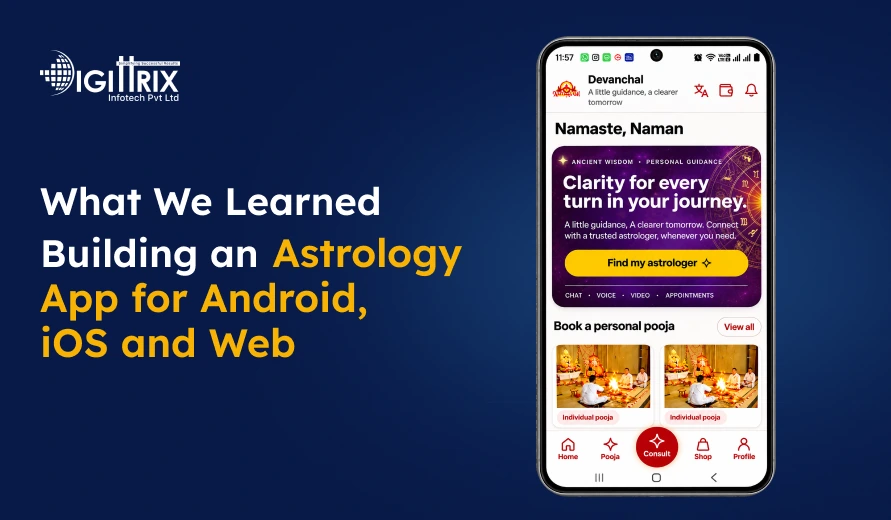
Building an astrology application for Android, iOS, and the web involves several decisions about platform selection, customer requirements, consultation workflows, payment systems, and data management. Astrology App Development also requires businesses to consider how customers interact with astrologers and how they manage different services on a single digital platform.
Digittrix has addressed these requirements through Devanchal, formerly Your Pandit Ji, an astrology and spiritual services platform. The project included website development, Android and iOS applications, Kundli access, astrologer consultations, pooja bookings, and mandir team management. The iOS application was developed but had not yet gone live on the App Store when the case study was published.
This project provides a practical reference for discussing several planning decisions involved in astrology products. These include defining user roles, selecting platform features, managing birth information, integrating reading services, and preparing applications for release. The following sections distinguish confirmed project details from general technical recommendations.
Planning an astrology app? Read Digittrix's Astrology App Development Cost in India guide to understand your first-year development budget!
1. Start Astrology App Development with a Clear Project Scope
The first planning decision is to identify what the application needs to offer and who will use it. A horoscope-reading application and an astrology consultation marketplace may share some features, but their operational requirements differ.
The Devanchal project brought together several services, including astrologer consultations, Kundli access, pooja bookings, remedies, and spiritual products. This meant the application needed to support more than basic customer registration and horoscope reading.
A useful starting point is to define three areas:
Customer requirements: Customers may need account registration, birth information, horoscope access, astrologer profiles, appointment booking, consultation history, and payment options.
Astrologer requirements: Astrologers may need profile management, availability settings, consultation requests, customer communication, and earnings information.
Administrative requirements: Administrators may need account management, astrologer verification, booking supervision, payment records, service management, and complaint handling.
However, these three groups may not cover every business requirement. The Devanchal project included tools to group several astrologers from the same mandir (temple) under a head poojari (head priest).
This is an important planning example. A business managing independent astrologers may need three basic roles, while a platform working with temple teams may require an additional supervisory role. The trade-off is greater administrative control, but with additional permission rules and dashboard requirements.
You can review the Devanchal website and mobile app development case study to confirm the project scope.
2. Select the Right Platforms and Technology
Choosing between native mobile development, cross-platform development, and web development depends on the intended customer journey.
Android applications need to support different device manufacturers, screen sizes, operating system versions, and permission settings. iOS applications require testing against Apple's device requirements, interface guidelines, and submission rules.
A web application offers another access point. Customers can visit a website through a browser to check services, read information, manage accounts, and request consultations.
In Devanchal, Digittrix developed the website and both Android and iOS applications. The Android customer-app demo presents navigation, astrologer profiles, pooja options, and product browsing. The iOS application was developed but was not yet live on the App Store. These are two different release states and should not be described as equivalent public availability.
Technology selection should consider the following factors:
- Expected number of users and supported devices.
- Need for native device functions.
- Shared code requirements across mobile platforms.
- Backend and database requirements.
- Real-time communication needs.
- Third-party API compatibility.
- Available development and maintenance resources.
Flutter or React Native may suit projects requiring shared mobile development. Native technologies may be appropriate when platform-specific functions require greater control. React.js can support web interfaces, while Node.js or Laravel can be considered for backend services.
The decision should follow the project requirements rather than a preference for a particular programming language.
3. Plan Features According to the First Release
An astrology product does not need every possible feature in its first release. The initial scope should align with the service the business intends to provide.
A content-focused application may require customer registration, horoscope content, a selected Kundli service, notifications, payment processing, and basic administration.
A consultation marketplace requires additional functions, such as astrologer registration, availability management, appointment scheduling, customer communication, and consultation records.
A platform offering spiritual services may also need pooja booking, product listings, ceremony updates, and separate management functions for mandir teams.
Devanchal demonstrates how multiple service categories can be consolidated into a single customer-facing platform. Its confirmed project scope includes consultations, Kundli access, pooja bookings, AI astrologers, reading API integrations, and reports available within customer chats.
The planning trade-off is straightforward: adding more services increases the number of workflows, integrations, permissions, and testing requirements. Businesses should decide which services are necessary at launch and which can be introduced later.
For a broader feature breakdown, see Digittrix's guide to building an online astrology consultation platform.
 Build an Advanced Astrology App for Your Business
Planning to launch an astrology app for Android, iOS, and web? Talk to Digittrix experts about your project requirements today.
4. Handle Birth Details, Historical Time Zones and Chart Calculations
Astrology applications may collect birth dates, birth times, and birthplaces to generate Kundli charts and planetary information. These details need careful processing because the calculation depends on the information supplied by the customer.
A birth information form should generally collect the date of birth, birth time, birthplace, and applicable location details. The system may use an external astrology API or a calculation engine to process the information.
One important technical requirement is historical time-zone handling. Software should use the time-zone rules applicable to the birth date and location, rather than applying the location's current UTC offset to every historical date.
The IANA Time Zone Database maintains historical local-time information, including changes to UTC offsets and daylight-saving rules. Developers can use appropriate time-zone data when processing historical birth information.
The application should also handle unknown birth times properly. It can ask customers to mark the time as unknown or approximate, explain that some calculations may be limited, and avoid presenting estimated information as an exact birth record.
Technical validation checks whether the system produces consistent results for the supplied birth details and selected calculation rules. It does not establish the predictive accuracy of astrological interpretations.
5. Build Consultation and Booking Workflows
An astrology consultation platform needs a clear process for connecting customers with available astrologers.
Customers should be able to view astrologer profiles, check consultation options, select an available time, and confirm a booking. The system must also prevent two customers from receiving the same appointment slot.
Booking rules should cover confirmation, cancellation, rescheduling, reminders, missed appointments, and refunds.
For chat, audio, and video consultations, developers should consider connection interruptions, call duration, notification delivery, and consultation status. The customer and astrologer should be able to identify whether a session is scheduled, active, completed, or cancelled.
A particularly important case involves payment after a temporary booking reservation expires. If payment succeeds but the appointment slot is no longer available, the application needs a defined recovery process. It should not confirm an unavailable appointment or automatically charge the customer again. The customer and support team should be able to see whether the booking requires reassignment, cancellation, or refund handling.
Recommended testing should include simultaneous booking attempts, repeated payment notifications, expired reservations, interrupted calls, and unsuccessful appointment confirmations. These are general quality checks, not claims about incidents in the Devanchal project.
Grow Your Business Without Marketing Overload with Our 1 Week Plan

Social Media Management

CRM

SEO

Website Maintenance

Get 7 days free
With experts handling Content, CRM, SEO, and Website Maintenance —no contracts, no upfront cost.


Limited free trial slots available — start your 1-week growth plan today

6. Choose Payment Methods According to the Paid Service
Payment integration should be planned based on what the customer is purchasing.
An astrology application may offer live one-to-one consultations, group sessions, premium horoscope reports, recorded sessions, digital subscriptions, or other paid content. These offerings may fall under different store billing rules.
Apple's App Store guidelines permit payment methods other than in-app purchase for qualifying real-time services between two individuals. However, one-to-few and one-to-many real-time services must use in-app purchase under the relevant guideline.
Google Play also provides an exception for qualifying one-to-one online paid services when the service is between two individuals and is not available for replay afterwards in a Play-distributed app.
Premium reports, subscriptions, and other digital content require separate billing consideration. Businesses should not assume that every consultation, wallet transaction, or paid feature qualifies for an exception.
The development team should classify each paid offering before selecting a payment gateway or store billing method. Regional programmes, purchase flows, and the latest platform rules should also be checked before release.
Useful official references include Apple's App Store Review Guidelines and Google Play's Payments Policy guidance.
7. Prepare for iOS App Store Review Before Development Ends
Developing an iOS application and securing its approval for public distribution are separate activities.
Apple identifies fortune-telling as an established App Store category. Under its review guidelines, new submissions in such categories must offer a meaningfully different or improved experience.
For an astrology business, this makes product differentiation an early planning requirement. The business should define what distinguishes its application, whether through consultation workflows, specialised services, original functionality, or a distinct customer experience.
The team should also prepare accurate app descriptions, screenshots, privacy information, account access details, and working purchase flows.
Completing development does not guarantee App Store approval. Review, rejection handling, and resubmission should each have separate time allocations in the project schedule.
8. Give Privacy and Access Permissions Proper Attention
Astrology platforms handle personal information, including birth dates, birthplaces, contact details, payment records, and consultation histories.
Access should be restricted to the information required for each user's responsibilities. Customers should be able to manage their accounts; astrologers should see relevant consultation details; and administrators should have permissions aligned with their assigned duties.
Key development considerations include secure authentication, role-based access control, protected API connections, encrypted communication, payment security, database backups, and data retention policies.
Applications with additional roles, such as head poojaris managing mandir teams, need permission structures that reflect those responsibilities. A supervisory role should not automatically receive unrestricted access to every customer or payment record.
Privacy and security requirements should be documented before implementation and verified during testing.
Build an Advanced Astrology App for Your Business
Planning to launch an astrology app for Android, iOS, and web? Talk to Digittrix experts about your project requirements today.
9. Test the Application Before Public Release
Testing should cover end-to-end customer and administrative workflows rather than checking individual screens in isolation.
For Android, testing should include supported devices, operating system versions, notifications, and permissions. For iOS, testing should cover device compatibility, navigation, account access, and purchase flows. Web testing should include responsive layouts, browser compatibility, and form submissions.
The team should also test account creation, birth-detail submission, horoscope access, consultation booking, payment confirmation, appointment cancellation, and report access.
For a platform with multiple user roles, testing should verify that each role can access the correct dashboard and perform only permitted actions.
Digittrix's Devanchal project also included Face Reading and Palm Reading API integrations, with report access added within customer chats. This illustrates why integration testing matters: the API response, report display, and consultation interface must work together.
The project case study also confirms improvements in website loading and API response times, but does not publish comparable before-and-after measurements. Therefore, specific performance percentages should not be attributed to this project.
10. Understand the Cost and Development Timeline
The budget and schedule depend on the number of platforms, user roles, integrations, and custom functions included in the project.
Digittrix publishes the following indicative development timelines based on reusable components and an agreed feature list:
- Focused customer-app MVP: generally around four to six weeks. This package covers one selected customer platform: Android, iOS, or a responsive website. It includes essential customer functions and basic administration, but does not include a separate astrologer application.
- Consultation marketplace MVP: generally around six to eight weeks. Its scope includes Android and iOS customer applications, a separate astrologer mobile application, and administrative functions for bookings, payments, reports, and moderation. A customer website is quoted separately for the consultation marketplace MVP, and the proposal specifies whether the astrologer app includes Android, iOS or both.
- Custom multi-platform product: generally eight weeks or more. Complex migrations, custom calculation engines, additional integrations, and larger platform requirements need separate estimation.
These timelines are planning estimates, not guaranteed delivery dates. The final proposal should identify included platforms, integrations, design work, testing, deployment responsibilities, and third-party dependencies.
For additional pricing and project-scope information, refer to the Digittrix astrology app development service page.
Building an astrology app? Read Digittrix's Guide to Building Astrology Apps That People Trust to understand how to create a secure and user-friendly astrology platform!
Final Words
Astrology products require careful planning across customer services, platform requirements, consultation workflows, payment rules, privacy, and release preparation. The Devanchal project shows how an astrology platform can support website and mobile access while bringing consultations, Kundli services, pooja bookings, reading reports, and mandir team management into its scope.
The main planning decision is to define the business model and user roles before selecting features or technologies. A focused customer application may need only one platform, while a consultation marketplace or multi-platform product requires additional development and testing.
Businesses should also account for historical birth-time data, store billing rules, app review requirements, and post-launch support. These decisions help establish a clear development scope and give the project a more realistic release plan.
 FAQ's